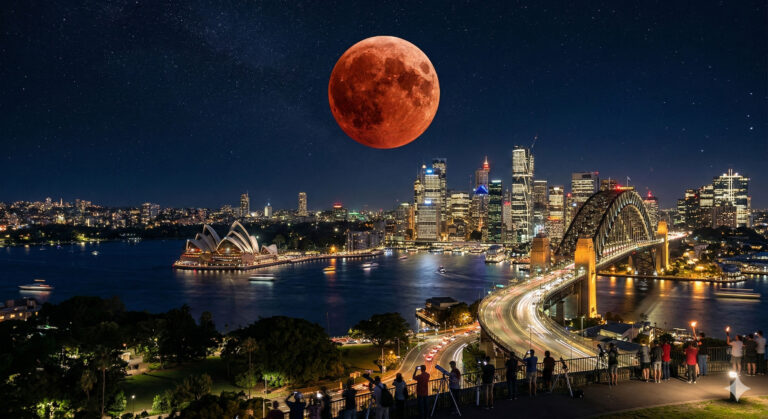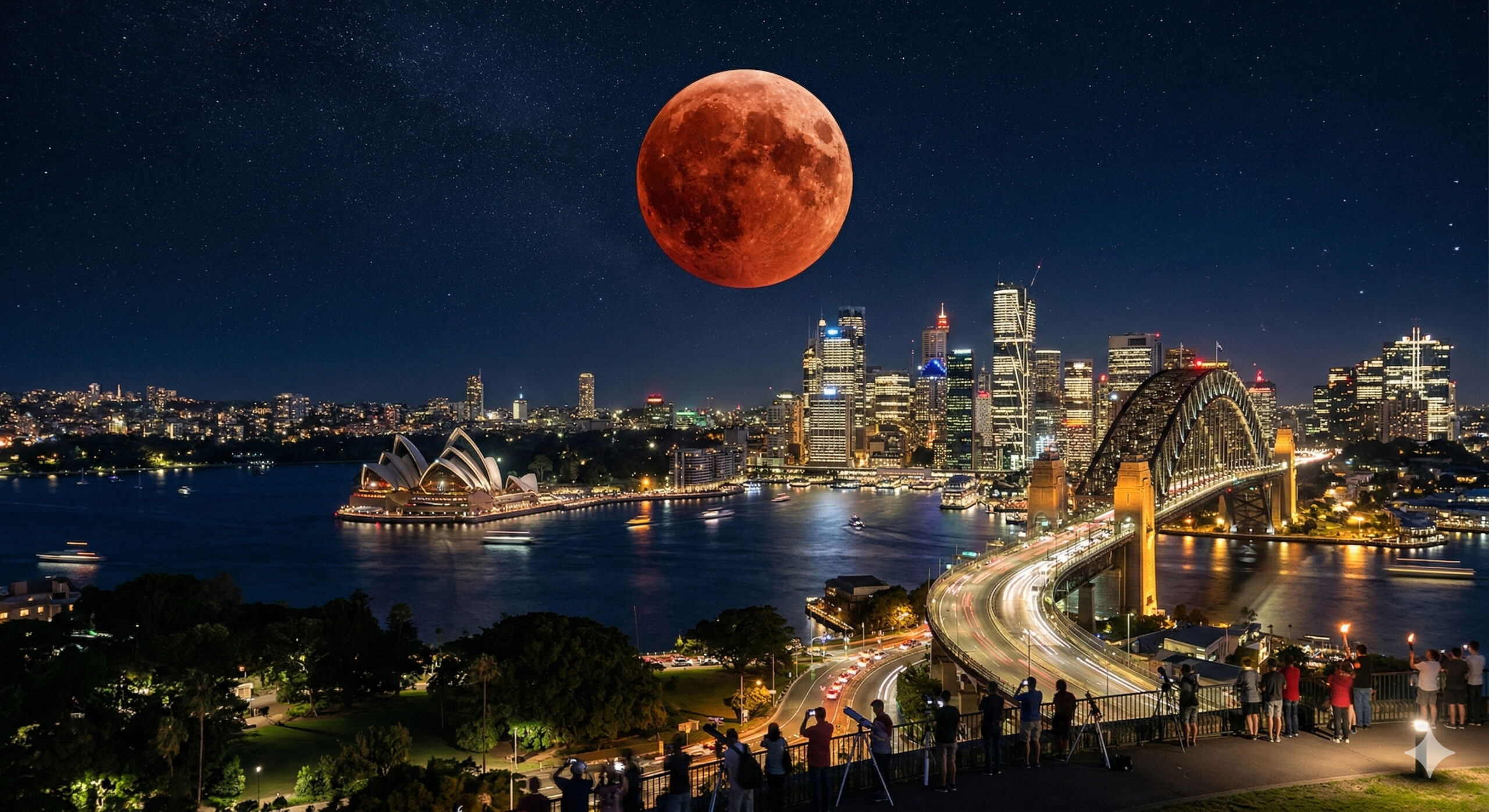
Tuesday, March 3, 2026 — Tonight, millions of Australians stepped outside to witness a hauntingly beautiful celestial transformation as the full moon faded from its usual silvery glow into a deep, coppery red. This phenomenon, famously known as a Blood Moon, is the result of a total lunar eclipse—the only one occurring in 2026 and the last the world will see until late 2028.
While the “Blood Moon” has historically been viewed as an omen of change or mystery, modern science offers a vivid explanation for this “cosmic sunset” currently painting the night sky over Perth, Sydney, Melbourne, and beyond.
Why is the Moon Red Tonight?
The moon does not produce its own light; it reflects sunlight. During a total lunar eclipse, the Earth moves directly between the Sun and the Moon, casting a massive shadow called the umbra.
You might expect the Moon to go pitch black once it enters this shadow, but it doesn’t. Instead, it glows red because of Rayleigh Scattering.
The Science of Rayleigh Scattering
As sunlight hits Earth’s atmosphere, the gas molecules scatter shorter blue wavelengths of light in every direction (which is why the sky is blue during the day). However, longer red and orange wavelengths pass through the atmosphere more easily.
During an eclipse, the Earth’s atmosphere acts like a lens, bending (refracting) this red light and focusing it onto the Moon. Essentially, the red glow you see on the Moon tonight is the combined light of every sunrise and sunset happening on Earth at this very moment, reflected back to your eyes.
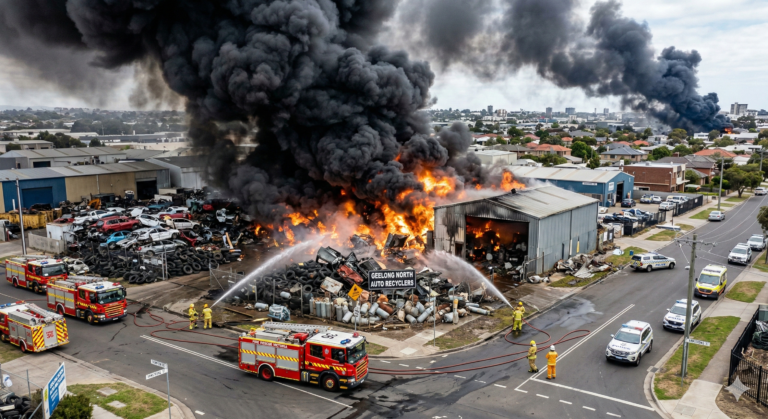
Pro Tip: The exact shade of red—ranging from bright orange to dark brick-red—depends on how much dust, smoke, or volcanic ash is in Earth’s atmosphere. Ironically, the industrial fire in North Geelong today might subtly contribute to a deeper crimson hue for local observers.
Visibility Guide: When and Where to Look
For those in Australia and the Pacific, tonight’s timing is nearly perfect for evening viewing.
Australia Capital City Timings (AEDT/AWST)
| City | Totality Begins | Maximum Eclipse | Totality Ends |
|---|---|---|---|
| Sydney / Melbourne | 10:04 PM | 10:33 PM | 11:02 PM |
| Adelaide | 9:34 PM | 10:03 PM | 10:32 PM |
| Brisbane | 9:04 PM | 9:33 PM | 10:02 PM |
| Perth | 7:04 PM | 7:33 PM | 8:02 PM |
| Darwin | 8:34 PM | 9:03 PM | 9:32 PM |
In Perth, the moon rose already partially eclipsed, providing a spectacular sight as it climbed over the eastern horizon already bathed in an eerie orange light.
What Does a Blood Moon Mean Spiritually?
Beyond the physics, the Blood Moon holds deep cultural and spiritual significance for many.
- Ancient Myths: The Incas believed a celestial jaguar was attacking the moon, while Mesopotamians saw it as an assault by demons.
- Modern Astrology: Many practitioners view tonight as a time of release and transformation. Because the eclipse falls in the sign of Leo this March, astrologers suggest it is a period for “cleansing the old” to make room for new beginnings, particularly in personal and professional lives.
- Religious Observance: In India, the Sutak Kaal (a period of abstinence and prayer) was observed today, with many temples closing their doors until the shadow passed.
Looking Ahead: The Next Eclipses
If you missed tonight’s display or have caught the “eclipse bug,” here is what is next on the celestial calendar for Australia:
- August 12, 2026: A Total Solar Eclipse will occur, though it will primarily be visible as a partial eclipse from Australia.
- August 28, 2026: A Partial Lunar Eclipse will offer another (though less dramatic) moon-watching opportunity.
- New Year’s Eve 2028: Mark your calendars for the next Total Lunar Eclipse (Blood Moon), which will ring in the 2029 New Year.
Red Moon Rising: Frequently Asked Questions About the 2026 Blood Moon
As the moon takes on its eerie crimson glow tonight, Australians from Perth to Sydney are looking to the skies with plenty of questions. Here is everything you need to know about the science, the timing, and the mystery behind the March 3, 2026, Total Lunar Eclipse.
1. Why is the moon red tonight?
The moon turns red due to a phenomenon called Rayleigh Scattering. During a total lunar eclipse, the Earth blocks direct sunlight from reaching the moon. However, Earth’s atmosphere bends (refracts) the longer red wavelengths of sunlight around the edges of our planet and onto the lunar surface. Essentially, you are seeing the reflection of every sunrise and sunset happening on Earth at this very moment.
2. Is it a “Blood Moon” or a “Lunar Eclipse”?
Both! “Blood Moon” is a popular, non-scientific term for a Total Lunar Eclipse. It refers specifically to the deep coppery or reddish color the moon assumes when it is completely submerged in the Earth’s dark inner shadow, known as the umbra.
3. What time is the eclipse at its peak?
In Sydney and Melbourne (AEDT), the maximum eclipse—when the moon is at its darkest red—occurs at 10:33 PM. For residents in Perth (AWST), the peak happens much earlier at 7:33 PM, shortly after moonrise.
4. How often does a Blood Moon occur?
Lunar eclipses happen roughly two to four times a year, but a total lunar eclipse (the red kind) is rarer. On average, you can see a Blood Moon from any given location on Earth about once every 2.5 years. After tonight, the next total lunar eclipse visible in Australia won’t occur until December 31, 2028.
5. Do I need special glasses to watch it?
No. Unlike a solar eclipse, which can damage your eyes if viewed directly, a lunar eclipse is perfectly safe to watch with the naked eye. The moon is only reflecting filtered sunlight, making it no brighter than a standard full moon. Feel free to use binoculars or a telescope for a clearer view of the lunar craters bathed in red.
6. Why isn’t every full moon a Blood Moon?
The Moon’s orbit around the Earth is tilted by about 5 degrees relative to Earth’s orbit around the Sun. Most of the time, the Moon passes slightly above or below Earth’s shadow. A Blood Moon only happens when the Sun, Earth, and Full Moon align perfectly in a straight line (an alignment called syzygy).
7. Does the red color mean something bad is going to happen?
In ancient history, red moons were often seen as omens of war or disaster. However, there is no scientific evidence linking lunar eclipses to physical disasters or human behavior. In modern astrology, tonight is often viewed as a time for reflection and emotional resetting.
About the Author