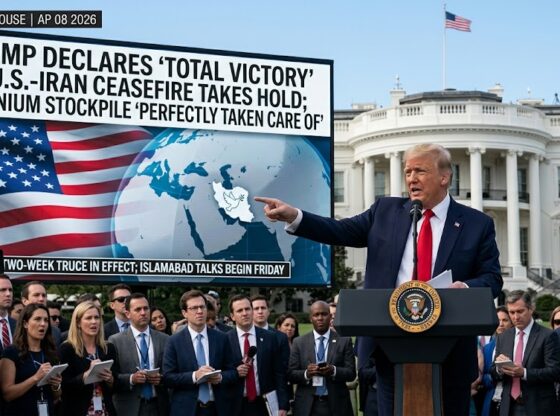

WASHINGTON, D.C Latest News. — In a dramatic early-morning announcement that has sent shockwaves through global capitals and financial markets, President Donald Trump declared a “total and complete victory” for the United States following the agreement of a pivotal two-week ceasefire with Iran. The deal, reached a mere hour before a 48-hour “obliteration” deadline was set to expire, marks a staggering de-escalation in a month-long conflict that has pushed the Middle East to the brink of a systemic collapse.
Speaking in a characteristically bullish telephone interview with AFP shortly after the truce was solidified, the President dismissed concerns regarding Iran’s sophisticated nuclear infrastructure. When pressed on the fate of Tehran’s highly enriched uranium stockpile—a central trigger for the recent hostilities—Trump was emphatic.
“That will be perfectly taken care of, or I wouldn’t have settled,” the President stated. “Total and complete victory. 100%. No question about it.”
The 11th-Hour Breakthrough
The ceasefire comes after four weeks of devastating U.S. and Israeli airstrikes aimed at Iran’s military and civilian infrastructure. The conflict intensified last month following the targeted assassination of Iran’s long-serving Supreme Leader, Ayatollah Ali Khamenei, in an opening salvo that decapitated the regime’s leadership.
As the U.S. prepared for a final, massive expansion of strikes against bridges and power plants, the President revealed that diplomatic backchannels facilitated by Pakistan and China had successfully brought Tehran to the table.
“I believe China helped get them there,” Trump noted, referencing his upcoming May summit with President Xi Jinping. “And I spoke with Prime Minister Shehbaz Sharif and General Asim Munir of Pakistan. They requested I hold off the destructive force we were sending tonight, and based on our conversations, I agreed.”
The Terms of the Truce
The two-week suspension of hostilities rests on a delicate 15-point framework. Key immediate developments include:
- The Strait of Hormuz: Iran has agreed to the “immediate and safe opening” of the vital waterway, though Tehran continues to describe this as “regulated passage” under the coordination of its own armed forces.
- Hostility Suspension: All direct military strikes between the U.S. and Iran are halted for 14 days.
- Islamabad Talks: Formal negotiations for a permanent resolution are scheduled to begin in Pakistan on Friday, April 10.
The Nuclear Question: ‘Perfectly Taken Care Of’
While the President did not provide specifics on the mechanism for securing the uranium, his “perfectly taken care of” comment suggests a significant concession may have been reached regarding international oversight or the removal of weapons-grade material.
Reports from the Arms Control Association suggest that the U.S. framework demands the total dismantlement of Iran’s enrichment program and zero enrichment in the future. However, International Atomic Energy Agency (IAEA) Director-General Rafael Grossi previously warned that Iran might be using “decoy canisters” to hide its 60% enriched uranium, making physical recovery a logistical and intelligence nightmare.
By asserting that the stockpile is no longer a threat, Trump appears to be betting on a breakthrough that satisfies his “Zero Enrichment” policy—a stance that led to the breakdown of previous negotiations.
Global Reactions: Relief and Skepticism
The announcement has triggered a wave of cautious optimism globally, though internal fractures remain visible among U.S. allies.
Israel: A Divided Front
In Jerusalem, Prime Minister Benjamin Netanyahu expressed support for the President’s decision but issued a stark clarification: The ceasefire does not extend to Lebanon. “Israel supports the decision to suspend strikes against Iran… subject to Iran stopping all attacks,” Netanyahu’s office stated. However, Israeli operations against Hezbollah—which have claimed over 1,500 lives in recent weeks—will continue unabated.
Conversely, Israeli opposition leader Yair Lapid slammed the move as a “political disaster,” accusing Netanyahu of being sidelined while the U.S. made decisions affecting Israel’s core security.
International Community
- United Nations: Secretary-General António Guterres welcomed the news, urging all parties to “comply with international law” and use the two weeks to build a “lasting and comprehensive peace.”
- United Kingdom: Prime Minister Keir Starmer announced an immediate trip to the Gulf to ensure the reopening of the Strait of Hormuz remains permanent, calling the truce a “moment of relief for the world.”
- Ukraine: Foreign Minister Andrii Sybiha praised “American decisiveness,” using the moment to call for similar U.S. pressure to end the Russian invasion.
Economic Ripple Effects
The news has provided a much-needed cooling effect on global energy markets. Oil prices, which had spiked to record highs as Iran threatened to permanently close the Strait of Hormuz, saw an immediate downward correction following the news of the reopening.
Market analysts at IATA (International Air Transport Association) noted that while the ceasefire is a positive step, jet fuel costs remain high due to the lingering risk of renewed conflict. “Governments must adopt greater energy security strategies,” IATA Chief Willie Walsh said today in Singapore.
A Test of Sovereignty
For Iran, the ceasefire is being framed not as a surrender, but as a strategic win. The Supreme National Security Council in Tehran issued a statement claiming the “enemy has suffered a crushing defeat,” while maintaining that their “hands remain upon the trigger.”
The Iranian 10-point counter-proposal demands the lifting of all sanctions and the recognition of their right to civilian enrichment—terms that directly contradict Trump’s “total victory” narrative.
What’s Next?
As the world holds its breath, all eyes turn to Islamabad this Friday. The two-week window is exceptionally narrow for resolving nearly five decades of hostility, a nuclear standoff, and the fallout of a month-long war.
For President Trump, the stakes are domestic as well as global. By claiming a “complete win” and asserting the nuclear threat is “taken care of,” he has tied his political reputation to the success of the Islamabad talks. Whether this is a true paradigm shift in Middle Eastern diplomacy or merely a pause before a larger storm remains to be seen.