
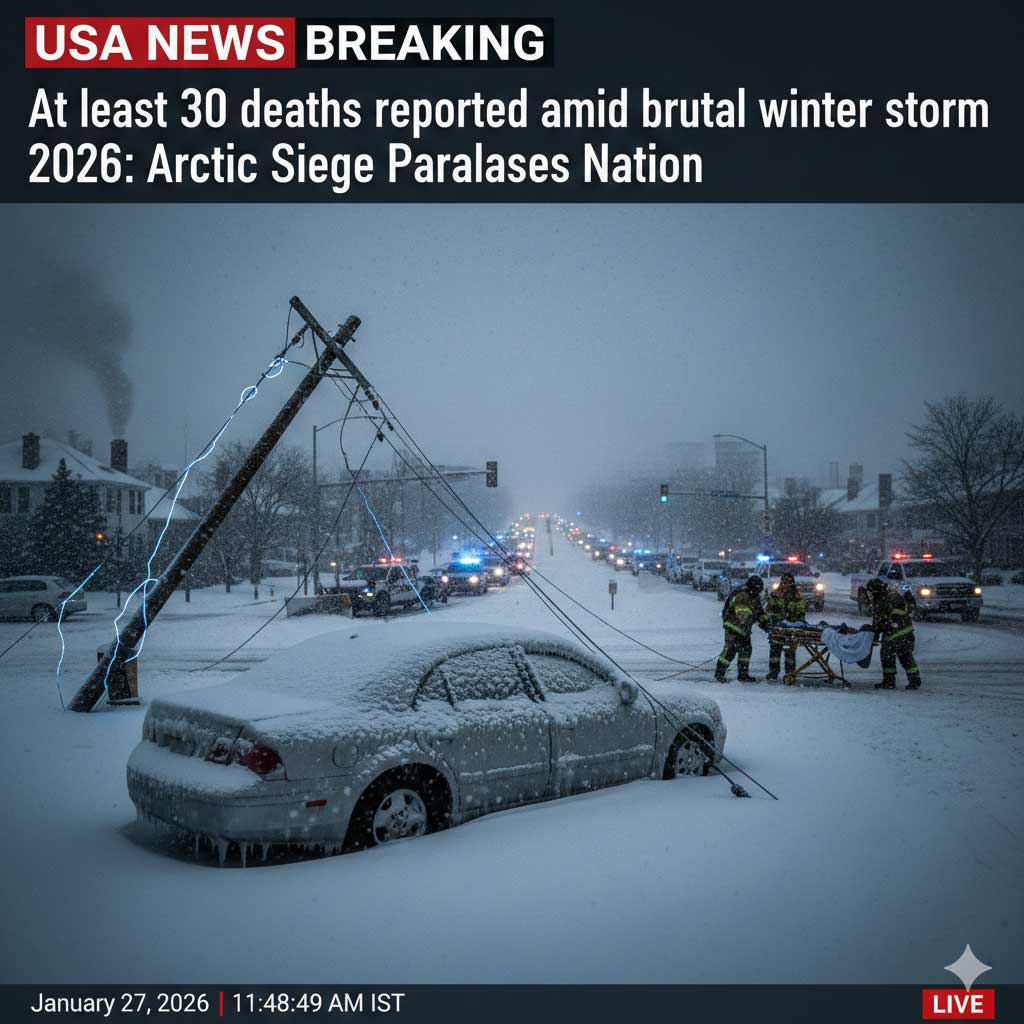
USA NEWS BREAKING At least 30 deaths reported amid brutal winter storm 2026: Arctic Siege Paralyses Nation
The United States is currently grappling with one of the most devastating meteorological events in recent history. A “monster” winter storm, described by officials as a relentless Arctic Siege, has carved a path of destruction from the Gulf Coast to the Canadian border. As of January 27, 2026, the human cost has become tragically clear: at least 30 deaths have been confirmed across multiple states, while millions of Americans remain under severe weather alerts.
From the frozen streets of New York City to the ice-encased neighborhoods of Mississippi and Tennessee, the 2026 winter storm has redefined the term “extreme weather.” This comprehensive report explores the catastrophic impact of the storm, the mounting casualties, the energy crisis triggered by skyrocketing natural gas prices, and the ongoing rescue efforts as nearly 100 million people brace for subzero temperatures.
The Human Toll: A Mounting Casualty Count
The most somber aspect of the January 2026 winter storm is the rising death toll. Authorities have confirmed that at least 30 people have lost their lives due to weather-related incidents. These fatalities span a wide range of causes, highlighting the diverse dangers posed by such a massive system:
- Exposure and Hypothermia: In New York City, Mayor Zohran Mamdani reported that several individuals were found deceased outdoors during the frigid weekend. Similarly, the Louisiana Department of Health confirmed multiple deaths due to hypothermia in Caddo Parish.
- Travel and Recreational Accidents: The storm’s icy grip turned roads and hillsides into death traps. In Texas, a 16-year-old girl tragically died in a sledding accident, while Arkansas and Ohio reported fatalities involving snowplows and ATVs.
- Infrastructure Failure: Falling trees and snapped power lines—weighing down by “catastrophic ice accumulation”—have caused fatal injuries in states like Tennessee and Mississippi.
“There is no more powerful reminder of the danger of extreme cold,” stated Mayor Mamdani. “We are seeing a sustained period of freezing temperatures that many of our cities haven’t experienced in nearly a decade.”
The “Arctic Siege”: State of Emergencies Declared
Governor Kathy Hochul of New York has termed the current weather pattern an “Arctic Siege.” The state has been hit by record-breaking cold, with upstate regions like Watertown and Copenhagen recording actual temperatures as low as -34°F and -49°F, respectively. These are not “wind chill” factors, but raw, bone-chilling temperatures that can cause frostbite in minutes.
States Under Pressure
More than 20 states, along with Washington D.C., have declared states of emergency. President Donald Trump has approved federal emergency disaster declarations for states including:
- Virginia and West Virginia
- Tennessee and Kentucky
- Arkansas and Louisiana
- Georgia and the Carolinas
In the South, where infrastructure is often not designed for prolonged freezing, the damage has been compared to the aftermath of a tornado. In Oxford, Mississippi, Mayor Robyn Tannehill noted that fallen limbs and lines have left the city looking like a war zone.
Power Grid Under Strain: 500,000+ Without Electricity
As of Monday evening, an estimated 565,000 customers remained without power. While some regions have begun to restore service, the sheer weight of the ice continues to cause new outages.
| State | Estimated Outages (Peak) | Primary Cause |
| Tennessee | 300,000+ | Ice-laden power lines |
| Mississippi | 100,000+ | Snapped poles & trees |
| Louisiana | 100,000+ | Freezing rain |
| Texas | 80,000+ | Grid strain & ice |
The Department of Energy has issued emergency orders to grid operators like PJM Interconnection and ERCOT, authorizing the use of backup resources to prevent a total grid collapse. In the South, where heating is largely electric, the lack of power is a life-threatening emergency.
Economic Impact: Natural Gas Prices Skyrocket
For the first time in over three years, natural gas prices have topped $6. The Arctic blast has created a “perfect storm” for the energy market:
- Demand Spike: 100 million people are using record amounts of gas for heating.
- Supply Disruption: Freezing temperatures have “knocked offline” nearly 10% to 12% of U.S. natural gas production as wells and pipelines freeze over.
- Market Volatility: Futures for February delivery surged nearly 30% in a single day, hitting a three-year high of $6.80 per million BTU.
This energy crisis is expected to reflect heavily on utility bills in the coming months, adding a financial burden to the physical toll of the storm.
Travel Paralysis: Thousands of Flights Canceled
The aviation sector has been grounded by the “monster storm.” According to FlightAware, over 15,000 flights within or into the U.S. have been canceled since the storm began.
Major hubs like Dallas-Fort Worth (DFW), Charlotte Douglas (CLT), and New York’s JFK have seen the highest numbers of scrapped flights. Airlines including Delta, American, and United have issued travel waivers, but with runways encased in ice and de-icing fluids running low in some regional airports, the backlog is expected to last through the week.
Safety Tips for the Arctic Siege
With subzero weather forecast to continue, authorities are urging citizens to follow strict safety protocols:
- Hunker Down: Stay off the roads. Travel is currently “perilous” in the Northeast and South.
- Prevent Pipe Bursts: Allow faucets to drip and keep cabinet doors open to circulate warm air.
- Safe Heating: Never use gas ovens or charcoal grills to heat your home, as carbon monoxide poisoning is a major risk during power outages.
- Check on Neighbors: Ensure elderly or vulnerable neighbors have adequate warmth and food.
Conclusion: A Week of Endurance
The winter storm of 2026 is far from over. As the system moves out, it leaves behind a frozen landscape and a grieving nation. With the death toll reaching at least 30 and natural gas prices signaling economic stress, the focus now shifts to recovery and restoration.
As Governor Hochul warned, “We are not through it. This is the beginning of a long, cold stretch.” The resilience of the American infrastructure and the bravery of first responders will be tested as the nation attempts to thaw out from this historic Arctic Siege.
Fo any query or info on insurance claiming, read below
Why You Need Death Insurance During an Arctic Siege
Standard health insurance covers your medical bills, but it doesn’t protect your family from the sudden loss of a breadwinner. In extreme weather events like the 2026 winter storm, Accidental Death and Dismemberment (AD&D) and Term Life Insurance are your primary lines of defense.
- Coverage for Natural Calamities: Most term life policies explicitly cover deaths caused by natural disasters, including extreme freezes and winter storms.
- Accidental Death Payouts: If a fatal accident occurs—such as a fallen tree during the storm or a weather-related car crash—an AD&D rider can double the payout to your beneficiaries.
- Immediate Financial Relief: With natural gas prices soaring over $6 and power outages affecting 500,000 homes, your family will need immediate liquidity to cover emergency relocation, heating costs, and funeral expenses.
Don’t Wait for the Next Frost—Act Now
| Policy Type | Benefit | Best For |
| Term Life Insurance | High payout (e.g., $1M) for any cause of death. | Total family protection. |
| AD&D Insurance | Lump-sum payout specifically for accidents. | High-risk commuters/workers. |
| Final Expense Insurance | Covers burial and funeral costs quickly. | Seniors & fixed-income families. |
How to Apply Today
- Get a Quote: Use an online aggregator to compare 2026’s top-rated providers like MetLife, Prudential, or State Farm.
- Check for “Weather Riders”: Ensure your policy includes coverage for natural disasters and accidental death.
- Appoint a Nominee: Clearly designate who will receive the benefits to ensure a smooth claim process during an emergency.
🚨 URGENT NOTICE FOR FAMILIES
If you have lost a loved one during this storm, contact your provider immediately. Most insurers have established Emergency Fast-Track Claims for victims of the 2026 Arctic Siege. You will typically need:
- Original Policy Documents
- Death Certificate
- Police Report (for accidental/road deaths)