
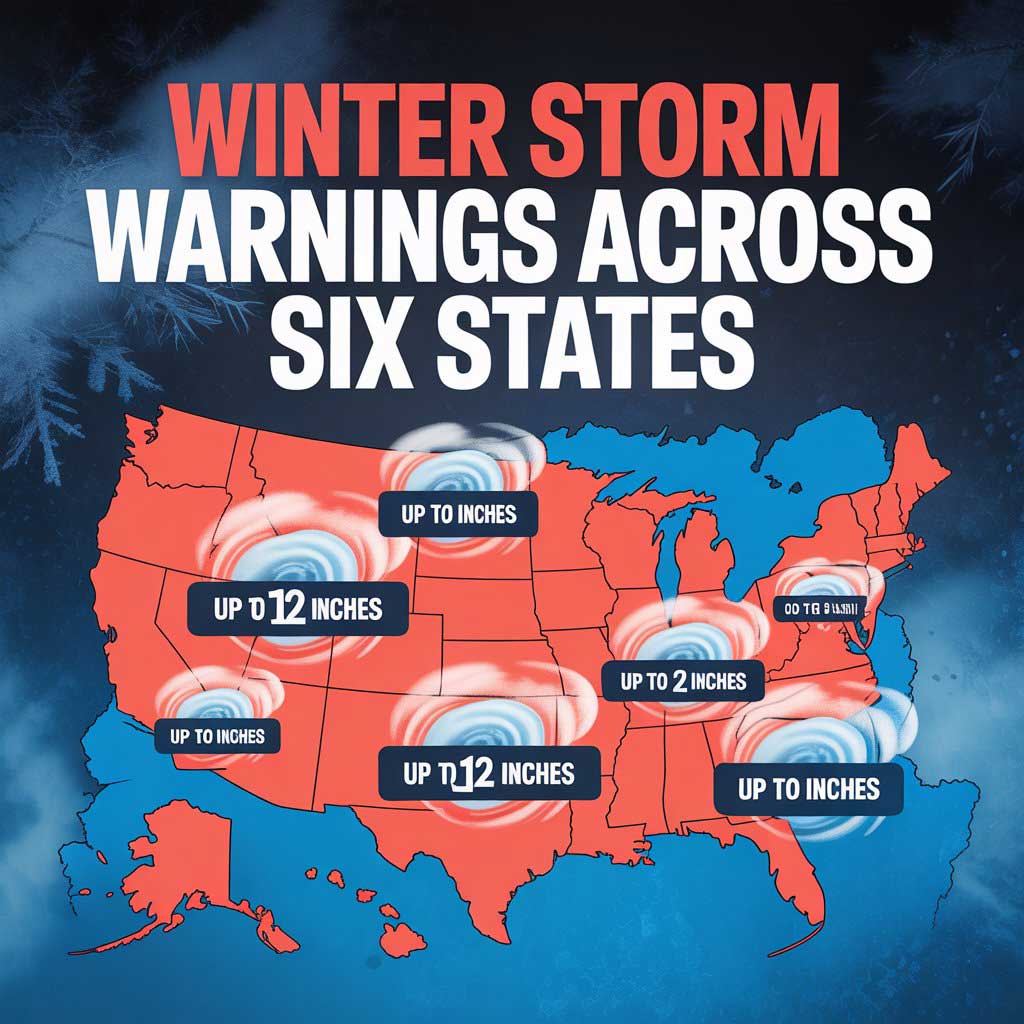
Winter Storm Warnings Issued Across USA Six States as Up to 12 Inches of Snow Looms
December 8, 2025
By Robert Smith
A powerful winter storm is moving across many parts of the United States. The National Weather Service (NWS) has issued winter storm warnings, advisories, and special weather statements for six states ranging from Alaska to the Southeast. Forecasters warn that this storm will strengthen from Sunday, Dec. 7, to Monday, Dec. 8. It is expected to bring changing conditions, heavy snowfall, and dangerous travel for millions of Americans.
Snowfall amounts will differ between regions. Forecasters say Alaska will experience the worst effects, with some communities expecting up to 12 inches. Parts of Wyoming, Michigan, South Carolina, Virginia, and Illinois will also face disruptive winter weather as the storm moves southeast and interacts with colder air across the country.
Here is a closer look at what to expect in each affected area, along with the latest meteorological guidance as the system develops.
Alaska: The Epicenter of the Weekend Storm
Forecasters expect the storm’s strongest effects to hit southeastern Alaska. A surge of cold air is mixing with a flow of moisture to create ideal conditions for heavy snowfall. Communities like Elfin Cove and Pelican could get 8 to 12 inches, while Kake and Port Alexander may see 3 to 5 inches, along with wind gusts that could exceed 40 miles per hour.
The NWS reports that a major change in weather patterns is causing these dramatic conditions. Cold air from the Arctic is mixing with moist air from the Pacific—a combination known for creating heavy snow in the panhandle and nearby islands.
Meteorologists note that heavy bands of snow are forming along the Icy Strait Corridor, where geography helps funnel cold air and increase precipitation. The NWS warns that this area will continue to experience moderate to heavy snowfall, especially as an advancing arctic boundary shifts southward from the Hoonah-Juneau area.
Residents in Haines, Pelican, Elfin Cove, and nearby towns should prepare for reduced visibility, drifting snow, dangerous wind chills, and slippery roads, particularly on untreated paths and elevated terrains.
Illinois: Light Snow but Major Travel Disruptions
In Illinois, especially the Chicago area, snowfall is expected to be only light—ranging from trace amounts to a couple of inches. However, the timing of the storm is problematic.
The storm arrives during one of the busiest travel times of the year. Even small amounts of snow in Chicago have caused significant delays in the past. By Saturday evening, hundreds of flights at O’Hare and Midway airports were already canceled or delayed, and more delays were likely if temperatures fell and winds picked up.
For drivers, melting snow during the day followed by freezing temperatures at night raises the risk of black ice, especially on bridges, overpasses, and less-traveled suburban roads. Local transportation officials have treated major expressways and advised commuters to be cautious during Monday morning travel.
Wyoming: Up to 10 Inches Expected in Mountain Regions
In the Mountain West, Wyoming is preparing for heavy snowfall in higher elevations, particularly in the Teton and Gros Ventre mountains. These areas could receive 6 to 10 inches, with locally higher amounts on windward slopes.
Forecasters explain that strong orographic lifting, when moist air is pushed up by mountains, will increase precipitation in these regions. The risk of avalanches in backcountry areas may also rise as new snow piles on top of older, hard-packed layers.
In Jackson, Moose, and Moran, snowy conditions could create dangerous driving along U.S. Highway 26/89/191, which may have quickly decreasing visibility during heavy snowfall. The NWS advises motorists on mountain passes to carry traction devices or snow tires and expect longer travel times.
Lower elevations across the state are likely to see lighter snowfall, but gusty winds could still cause drifting snow and isolated whiteout conditions.
Michigan: Lake-Effect Snow to Create Sharp Weather Contrasts
Michigan’s winter storm situation is less about heavy snow overall and more about the variability of lake-effect snow, especially downwind of Lake Superior.
Communities in Central Chippewa and Western Chippewa counties may see up to six inches of snow as cold air interacts with warm moisture over the lake. These narrow bands can create stark differences over short distances—one town can be buried under snow while another nearby remains almost dry.
“During lake-effect snow, the weather can shift from heavy snow to dry conditions just a few miles away,” the NWS said in a public statement, highlighting the unpredictable nature of these events.
Fluctuating visibility, sudden wind gusts, and icy surfaces will make travel especially difficult along Interstate 75 and parts of M-123. Residents are advised to monitor real-time radar and local alerts, as lake-effect conditions can change quickly.
South Carolina and Virginia: Rare Early-Season Snow in the Southeast
Perhaps the most surprising effects of this storm are expected farther east, where parts of South Carolina and Virginia may see up to 5 inches of snow. This event would be a rare occurrence for the region.
This snowfall results from cold air moving into the Southeast just as a second low-pressure area forms along the Atlantic coast. Although this system is not likely to develop into a full storm, forecasters believe it will be enough to generate accumulating snow across parts of the Appalachians and Piedmont region.
South Carolina typically sees snow only a few times a decade. Snow in December usually disrupts travel, closes schools, and can cause power outages from heavy snow weighing down trees and power lines.
Higher elevations in Virginia—particularly areas west of Charlottesville and near the Blue Ridge—may face the most severe conditions. Travel impacts are likely from Sunday night into Monday. Some areas might experience a wintry mix that shifts to pure snow as temperatures drop, complicating road conditions further.
State emergency management agencies are urging residents to prepare their vehicles with blankets, charged batteries, and emergency kits, especially when traveling through mountainous regions.
A Storm Driven by a Powerful Pattern Shift
Meteorologists attribute the broad, multi-state impact of this storm to a significant change in atmospheric patterns. A large trough moving across the western U.S. has allowed cold, arctic air to move south, while multiple moisture sources—including Pacific flow into Alaska and Atlantic moisture heading into the Southeast—have created the right conditions for widespread winter weather.
This collision of cold air and warm, moist systems often leads to early-winter storms. However, this event is notable for its extensive reach, affecting areas as different as coastal Alaska, the Great Lakes, and the deep Southeast all within the same 24 to 36 hours.
Travel Impacts and Safety Recommendations
The NWS continues to highlight the risk of rapidly changing weather, especially in areas affected by mountain snow or lake-effect bands. Conditions can worsen quickly, roads may shift from wet to icy in minutes, and strong winds may reduce traction and blow snow across highways.
Officials recommend:
- Delaying non-essential travel, especially overnight when temperatures drop.
- Keeping vehicles stocked with snow brushes, water, blankets, and emergency supplies.
- Allowing extra time for commutes and regularly checking local weather alerts.
- Avoiding distractions and using headlights in snowy or foggy conditions.
- Preparing homes for strong winds and possible power outages.
Air travellers are advised to frequently check flight statuses and arrive early, as airport de-icing can prolong boarding and departure times.
What Comes Next?
Meteorologists predict the storm will start to weaken by late Monday as energy shifts offshore and colder air settles across central U.S. areas. However, lingering snow showers are expected in the Great Lakes, and Alaska may continue to see occasional snowfall as moisture remains in the region.
Long-range forecasts suggest that colder-than-average temperatures could stick around in the northern U.S. into mid-December, raising the chance for more winter weather systems in the following weeks. The Southeast might, however, return to more typical temperatures after the snow event.
For now, the NWS urges residents in affected states to stay alert, as conditions may change faster than the forecast models can account for.