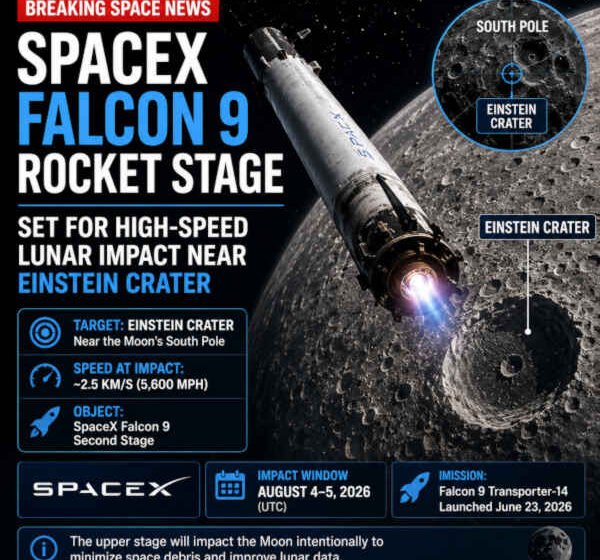
SpaceX Falcon 9 Rocket Stage Set for High-Speed Lunar Impact Near Einstein Crater

CAPE CANAVERAL, Fla. — In a rare and scientifically intriguing celestial event, a spent four-ton upper stage of a SpaceX Falcon 9 rocket is on a collision course with the Moon. Travelling at approximately 2.43 kilometres per second (about 8,700 km/h or 5,400 mph)—more than seven times the speed of sound—the discarded rocket body is projected to slam into the sunlit western limb of the lunar surface on Wednesday, August 5, 2026, at approximately 06:35 UTC (2:35 a.m. EDT).
The impact will occur on the Earth-facing side of the Moon near Einstein Crater, carving out a fresh crater estimated to be 20 to 30 meters wide and five meters deep. While the collision poses no danger to Earth or existing lunar infrastructure, it provides astronomers and planetary scientists with a unique opportunity to observe an artificial impact in real time and analyse the resulting dust plume and shock dynamics.
SpaceX Rocket Moon key Impact
| Parameter | Measurement / Value |
| Object Identification | SpaceX Falcon 9 Upper Stage (JPL ID: 2025-010D) |
| Launch Date | January 15, 2025 (Kennedy Space Center) |
| Target Impact Location | Near Einstein Crater (19.46° N, 93.29° W) |
| Predicted Impact Time | August 5, 2026, at ~06:35:37 UTC (2:35 a.m. EDT) |
| Impact Velocity | 2.43 km/s (~8,700 km/h / 5,400 mph) |
| Dimensions & Mass | ~12 meters long, 4 meters wide; ~3,900 to 4,000 kg |
| Kinetic Energy Released | ~11.8 Gigajoules (equivalent to ~2.8 to 3.0 tons of TNT) |
| Expected Crater Dimensions | 20–30 meters wide, ~5 meters deep |
How Did a Spent Rocket Stage End Up on a Lunar Collision Course?
The story of rocket body 2025-010D began on January 15, 2025, when a SpaceX Falcon 9 lifted off from Florida carrying two high-profile commercial lunar landers: Firefly Aerospace’s Blue Ghost Mission 1 and Japanese company ispace’s Hakuto-R Resilience.
After executing a successful orbital insertion that propelled both landers toward their lunar destinations, the Falcon 9’s second stage depleted its remaining fuel. Unlike lower-orbit missions where second stages execute deorbit burns to safely burn up in Earth’s atmosphere, high-energy lunar trajectories often leave spent upper stages trapped in chaotic “cis-lunar” orbits.
                 EARTH-MOON CIS-LUNAR TRAJECTORY

      +-------+                                     +-------+
      | EARTH | ===== [Jan 15, 2025 Launch] =======> | MOON  |
      +-------+                                     +-------+
          \                                             /
           \---> Unstable Orbit (Gravitational Drift) --/
                 • Earth, Moon & Solar radiation pressure
                 • Detected in May 2026 by Bill Gray
                 • Direct Impact: Aug 5, 2026 (~06:35 UTC)
For more than 18 months, the 12-meter hollow metal cylinder drifted through space, influenced by gravitational forces from the Earth, Moon, and Sun, as well as minor thrust-like effects from solar radiation pressure. In May 2026, orbital tracker Bill Grey, developer of the widely used Project Pluto astronomical tracking software, feeding orbital tracking data into physics models, determined that the stage’s chaotic path would culminate in a direct impact on the Moon’s sunlit western edge.
The Physics of the Impact: Flash, Plume, and Shockwaves
Though the kinetic energy released during the impact will equal roughly three metric tons of TNT, the event is not an explosive detonation. Instead, it represents a hypervelocity kinetic transfer:
-
The Initial Flash: Upon contact, the structural aluminium of the rocket and the lunar regolith (soil) will vaporise instantly, converting kinetic energy into heat and shockwaves. However, because the collision will take place on the illuminated side of the Moon, the flash will be extremely brief (lasting less than a second) and faint against the bright, sunlit surface.
-
The Debris Curtain: The primary focus for professional observatories is the resulting ejecta plume. Due to the Moon’s weak gravity (one-sixth of Earth’s) and complete lack of atmospheric drag, pulverised lunar soil, rock fragments, and shredded metal pieces will be thrown high above the surface.
-
Plume Altitude: Computer simulations suggest that the primary curtain of lunar dust could reach altitudes of 15 to 20 kilometres, with higher-velocity particle jets potentially expanding up to 75 to 100 kilometres before settling back down.
EJECTA PLUME HEIGHT ESTIMATES
---------------------------------------------------------------------------------
Main Dust Curtain  : [============                    ] 15 - 20 km
High-Velocity Jet  : [================================] 75 - 100 km
---------------------------------------------------------------------------------
Because the impact site sits near the lunar limb (the visible edge of the Moon as seen from Earth), scientists anticipate that part of the rising dust cloud may extend beyond the illuminated crescent and stand out against the backdrop of dark space.
Observation Guide: How and Where to Watch
While the impact cannot be seen with the naked eye, amateur and professional astronomers equipped with medium-to-large ground-based telescopes and high-speed digital imaging cameras have a window of opportunity.
                     GLOBAL OBSERVATION CONDITIONS

   +---------------------------------------------------------------+
   | North America (Eastern / Central) & South America             |
   | • Nighttime hours | Moon high above horizon | Optimal Viewing  |
   +---------------------------------------------------------------+
                                   |
   +---------------------------------------------------------------+
   | Europe, Asia, Middle East, Africa                             |
   | • Daylight / Moon below horizon | Extremely Difficult         |
   +---------------------------------------------------------------+
-
Best Viewing Locations: The timing heavily favors observers across the Eastern and Central United States, Eastern Canada, and much of South America, where the Moon will be high in the dark night sky at 2:35 a.m. EDT / 1:35 a.m. CDT.
-
Challenging Regions: In Europe, Africa, and Asia, the impact occurs during daylight hours or after moonset, rendering ground-based optical observation virtually impossible.
-
Recommended Equipment: Astronomers are using specialized high-frame-rate monochrome cameras attached to telescopes with apertures of 8 inches or larger, recording video at dozens of frames per second to capture any brief dimming or plume shadow.
Orbital Reconnaissance: Danuri & Lunar Reconnaissance Orbiter
While ground-based telescopes attempt to capture the immediate plume, space agencies will utilise orbiting spacecraft to document the event before, during, and after impact.
           SATELLITE RECONNAISSANCE TIMELINE

  T - 2 Minutes  : South Korea's Danuri spacecraft passes within
                   kilometers of the rocket stage trajectory.
  T = 0          : Impact near Einstein Crater (~06:35 UTC).
  Post-Impact    : NASA's Lunar Reconnaissance Orbiter (LRO)
                   executes flyovers to photograph the fresh crater.
South Korea’s Danuri (KPLO) orbiter is scheduled to pass within a few kilometres of the rocket stage’s incoming flight path just two minutes prior to impact, offering a chance for close-range tracking. In the days following the crash, NASA’s Lunar Reconnaissance Orbiter (LRO) will manoeuvre over the Einstein Crater region, taking high-resolution before-and-after photographs to confirm the exact impact point, crater dimensions, and regolith displacement patterns.
Cis-Lunar Space Debris: A Growing Environmental Challenge
This collision marks only the second known instance of an untracked piece of space debris accidentally crashing into the Moon. In March 2022, a spent upper stage from a Chinese lunar mission struck the far side of the Moon, leaving behind a distinctive double crater.
While these impacts do not pose direct hazards to Earth, space policy experts emphasise that they highlight an urgent regulatory gap in managing cis-lunar space debris.
As nations and commercial companies scale up robotic and crewed exploration under programs like NASA’s Artemis and international lunar base initiatives, high-velocity impacts could pose risks:
-
Ejected regolith and debris fragments can travel hundreds of kilometres across the airless lunar landscape.
-
High-speed dust clouds could scour sensitive solar arrays, optical sensors, or surface habitats.
-
Uncontrolled upper stages complicate orbital navigation for active lunar communication satellites.
Scientists hope that data gathered during the August 5 impact will refine mathematical models predicting how impact debris disperses across the Moon, helping space agencies protect future infrastructure and astronauts on the lunar surface.
Frequently Asked Questions (FAQ)
Will the SpaceX rocket impact be visible to the naked eye?
No. The impact flash will be brief and occur against a sunlit area of the Moon, making it invisible without specialised astronomical telescopes and high-speed camera sensors.
Is there any danger to Earth or satellites in Earth orbit?
None whatsoever. The impact occurs entirely on the lunar surface, 384,000 kilometres away from Earth. The debris ejected will fall back to the Moon.
Why wasn’t the rocket stage deorbited back to Earth?
High-energy launches carrying payloads to the Moon require significant velocity. Once the upper stage deployed its lander payloads, it lacked remaining propellant to execute a targeted Earth deorbit burn, leaving it in a chaotic Earth-Moon transfer orbit.