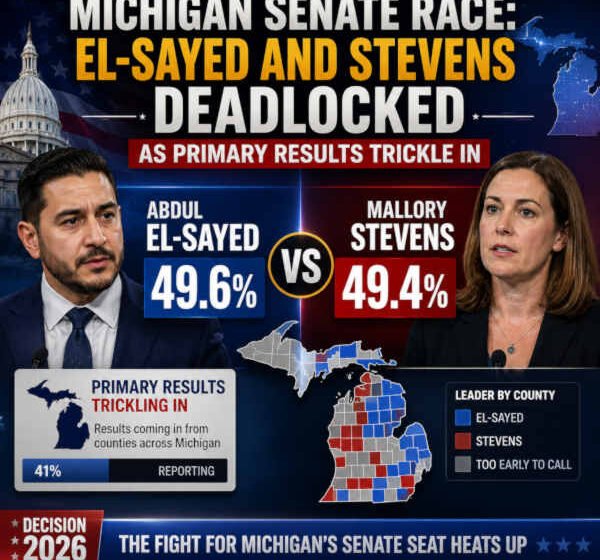
Michigan Senate Race: El-Sayed and Stevens Deadlocked as Primary Results Trickle In

DETROIT : As preliminary election returns trickled in late Tuesday night across Wayne, Oakland, and Kent counties, Michigan’s high-stakes Democratic U.S. Senate primary transformed into a high-volatility battlefield. The fiercely contested primary pits four-term establishment Representative Haley Stevens against progressive health administrator Dr. Abdul El-Sayed, serving as an ideological barometer for the Democratic Party heading into the 2026 midterm election cycle.
The high-profile primary took centre stage on Fox News’ Hannity, where a panel of political strategists, campaign consultants, and media analysts evaluated early results and debated how the deep fracture between the Democratic Socialists of America (DSA)-backed progressive wing and moderate establishment Democrats will impact control of the U.S. Senate in November.
Early Returns Show Tight Race in Battleground Michigan
With over 1 million early and mail-in ballots cast prior to Primary Day, early returns showed El-Sayed holding narrow leads in urban precincts, while Stevens narrowed the margin as suburban returns from Oakland and Macomb counties were tallied.
================================================================================
MICHIGAN DEMOCRATIC U.S. SENATE PRIMARY (2026) - KEY CANDIDATE SNAPSHOT
================================================================================
Candidate           Ideological Wing     Key Endorsements            Primary Strategy
--------------------------------------------------------------------------------
Rep. Haley Stevens  Moderate / Centrist  Gov. Gretchen Whitmer,       Pragmatic "Workhorse",
                                         Sen. Leader Chuck Schumer,  Focus on Manufacturing,
                                         Gary Peters, AIPAC / UDP    Legislative Track Record

Dr. Abdul El-Sayed  Progressive / Left   Sen. Bernie Sanders,        Universal Healthcare,
                                         Rep. Alexandria Ocasio-   Corporate Accountability,
                                         Cortez, Justice Democrats   Grassroots Mobilization
================================================================================
The Senate seat, opened by the retirement of Democratic Senator Gary Peters, is considered a must-hold fortress for the party if it hopes to flip the Republican-controlled upper chamber in November. The winner of Tuesday’s primary will face former Republican Representative Mike Rogers in the general election.
Hannity Panel Weighs In: The Establishment vs. DSA Fracture
During Tuesday night’s edition of Hannity, panelists dissected the tactical and ideological tensions tearing at the Democratic base.
Discussion focused on how the rise of left-wing primary challengers in Midwestern battleground states is forcing national Democratic fundraising committees and corporate political action committees (PACs) to divert vast capital reserves into defensive primary battles.
“What you are seeing play out in Michigan tonight is not just a primary election—it is a full-scale war for the soul and branding of the Democratic Party,” noted one political analyst on the panel. “When progressive populists push for massive regulatory shifts and universal healthcare mandates in a Rust Belt swing state, it creates huge friction with moderate voters who prioritize economic stability and manufacturing job growth.”
Panelists highlighted two distinct visions presented to Michigan voters:
-
The Stevens Approach: Built on moderate pragmatism, legislative accomplishments, and strong ties to labor unions, automotive manufacturing, and defense technology sectors. Stevens pitched herself as a proven “workhorse” capable of winning moderate and independent voters in general election swing districts.
-
The El-Sayed Platform: Rooted in grassroots populism, El-Sayed campaigned on universal Single-Payer healthcare, environmental regulation, and strict opposition to corporate PAC money and foreign military aid packages. Backed by Senator Bernie Sanders and Representative Alexandria Ocasio-Cortez, El-Sayed sought to replicate progressive primary victories seen in urban centers nationwide.
The $100 Million Money Machine: Record-Breaking Ad Spending
The Michigan Democratic primary stands out as the third most expensive Senate primary in U.S. political history, according to ad-tracking platform AdImpact. Total ad buys and airtime reservations reached nearly $98.2 million leading up to August 4.
+-------------------------------------------------------------------------------+
|             2026 MICHIGAN DEMOCRATIC SENATE PRIMARY SPENDING MATRIX            |
+-----------------------------------+-------------------------------------------+
| Total Estimated Ad Spending       | $98.2 Million                             |
| Outside Super PAC Share           | ~88% of Total Primary Ad Volume           |
| Major Outside Advertisers         | United Democracy Project (UDP / AIPAC),   |
|                                   | Progressive Victory, Labor Super PACs     |
| Key Media Channels                | Broadcast TV, Programmatic Digital Video,  |
|                                   | OTT Streaming Services, Targeted Direct Mail|
+-----------------------------------+-------------------------------------------+
Outside spending accounted for an astonishing 88% of all advertisement funding in the race. Prominent legal entities, corporate political action committees, and independent expenditure groups flooded the airwaves across Detroit, Grand Rapids, and Flint.
A substantial portion of these funds flowed through political action committees like the United Democracy Project (UDP)—an affiliate of AIPAC—which ran targeted broadcast and digital ad campaigns opposing El-Sayed over his foreign policy stances and backing Stevens.
Strategic Implications for the 2026 Midterm General Election
As political consultants, wealth management advisors, and corporate compliance lawyers monitor the fallout from the August 4 primaries, the general election match-up presents significant strategic choices for both parties.
1. General Election Risk Assessment
Republican candidate Mike Rogers, who narrowly lost his 2024 Senate bid to Democrat Elissa Slotkin, ran unopposed in the GOP primary, allowing his campaign to conserve cash and focus entirely on general election messaging. A prolonged, bitter recount or fractured base following Tuesday’s Democratic primary could leave the eventual nominee financially drained and facing internal party friction.
2. Digital Media and Campaign Compliance Trends
The 2026 midterm cycle has seen a surge in programmatic digital advertising, AI-driven voter analytics, and sophisticated campaign finance structuring. Political consulting firms and corporate legal teams are paying close attention to independent expenditure compliance, Federal Election Commission (FEC) disclosures, and media buys on streaming platforms.
3. Economic Policy & Market Stability
Financial markets, commercial real estate developers, and manufacturing executives in Michigan closely monitor state election outcomes. A progressive shift in the Senate could signal increased momentum for corporate tax adjustments, stricter environmental compliance mandates, and heightened antitrust oversight. Conversely, a victory by moderate candidates like Stevens reassures institutional investors seeking regulatory continuity in the Midwest.
The Road to November
The close margins in Michigan reflect broader national trends across the 2026 primary calendar. As the Hannity panel concluded, whether the Democratic nominee is a progressive reformer or a moderate pragmatist, the road to controlling the United States Senate runs directly through the industrial heartland of Michigan.
With millions of dollars in political advertising already locked in for the autumn campaign, Michigan voters can expect non-stop media exposure as both major parties prepare for one of the most expensive and decisive general election battles of the decade.