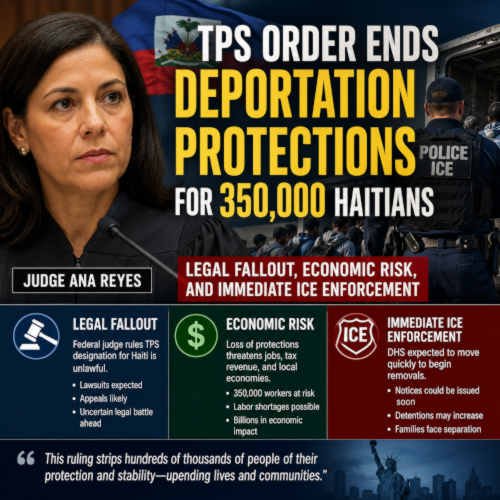
Judge Ana Reyes TPS Order Ends Deportation Protections for 350,000 Haitians: Legal Fallout, Economic Risk, and Immediate ICE Enforcement

USA News: In a landmark decision that concludes months of intense legal uncertainty, U.S. District Judge Ana Reyes has officially lifted the stay protecting roughly 350,000 Haitian nationals from deportation, paving the way for the federal government to terminate Temporary Protected Status (TPS) for the group.
The order, issued by Judge Reyes, marks the formal implementation of a Supreme Court ruling from earlier this summer that cleared the path for the Department of Homeland Security (DHS) to end the humanitarian program for Haiti. Effective immediately, Haitian TPS holders across the United States have lost their legal authorisation to work, exposing hundreds of thousands of non-criminal residents to immediate removal to a country struggling with severe political instability and widespread violence.
The Legal Pathway to Revocation
The ruling by Judge Reyes represents the final procedural step following a high-stakes legal battle that reached the nation’s highest court. Earlier this year, Reyes, an appointee of former President Joe Biden, issued a preliminary injunction halting the administration’s plans to terminate TPS for Haitians. Her initial ruling concluded that Homeland Security officials had likely skirted statutory requirements and that the decision may have been driven by racial animus against Haitian migrants.
However, the Supreme Court reversed that injunction in late June, establishing that federal courts lack the statutory authority to review challenges regarding how the Homeland Security secretary exercises discretion under the law to terminate TPS designations for foreign nations.
“The court’s order, which had stayed the effective date of Department of Homeland Security Secretary’s Termination of the Designation of Haiti for Temporary Protected Status pending judicial review, is no longer in effect,” Judge Reyes wrote in her brief order.
While the administrative termination is now active, the underlying lawsuit is not entirely dead. Attorneys representing Haitian TPS holders are continuing to pursue equal protection claims, arguing that the administration acted with discriminatory intent. The Supreme Court’s ruling left open the possibility for plaintiffs to present further evidence regarding constitutional equal protection violations.
TPS LEGAL BATTLE MILESTONES
┌─────────────────────────┬────────────────────────────────────────────────────────────────────────┐
│ Date                    │ Event / Judicial Action                                                │
├─────────────────────────┼────────────────────────────────────────────────────────────────────────┤
│ Early 2026              │ District Court halts DHS attempt to end Haitian TPS, citing procedures. │
├─────────────────────────┼────────────────────────────────────────────────────────────────────────┤
│ Late June 2026          │ Supreme Court reverses lower court injunction, limiting judicial review.│
├─────────────────────────┼────────────────────────────────────────────────────────────────────────┤
│ August 2026             │ District Judge Reyes officially dissolves stay, ending TPS for Haitians.│
├─────────────────────────┼────────────────────────────────────────────────────────────────────────┤
│ Ongoing                 │ Plaintiffs continue gathering evidence on Equal Protection claims.     │
└─────────────────────────┴────────────────────────────────────────────────────────────────────────┘
Immediate ICE Enforcement and Ankle Monitors
With the legal stay dissolved, federal immigration authorities have swiftly activated plans to target former TPS recipients whose work permits and protections have expired. U.S. Immigration and Customs Enforcement (ICE) has already begun contacting individuals to report to field offices, with several Haitian nationals being fitted with electronic ankle monitors—an alternative-to-detention measure used to restrict movement and track individuals ahead of potential removal.
DHS Secretary Markwayne Mullin signaled an uncompromising approach to enforcement during recent public statements, confirming that immigration agents are actively locating individuals whose legal status has lapsed.
“We’re going after them right now,” Secretary Mullin stated in a broadcast interview. “These individuals can either self-deport or we’ll arrest you and send you back. It’s that simple.”
Legal advocates representing TPS recipients expressed deep concern over the immediate enforcement push, pointing to the perilous conditions currently gripping Haiti, where civil infrastructure has collapsed under gang control and the State Department maintains a Level 4 “Do Not Travel” advisory due to extreme kidnapping and violent crime.
“As a result of today’s order implementing the Supreme Court’s decision, Haitian TPS holders – all of them non-criminals – can no longer legally work, and many are subject to removal to Haiti, which continues to be one of the most dangerous countries in the world,” said Geoff Pipoly, an attorney representing the plaintiffs.
Severe Disruptions Across Elder Care and Key Industries
The loss of work authorisation for nearly 200,000 gainfully employed Haitian TPS holders is triggering immediate shockwaves throughout the U.S. labour market, with the elder care sector suffering the most acute impact. Nursing homes, assisted living facilities, and home healthcare agencies across the country rely heavily on Haitian workers filling vital roles as Certified Nursing Assistants (CNAs), dietary aides, and environmental service staff.
Several long-term care operators have already begun terminating Haitian employees whose work permits lapsed, while others are grappling with how to replace long-tenured staff in an industry already plagued by severe labour shortages.
| Economic & Labour Impact Metric | Estimated Value / Volume | Primary Affected Sectors |
| Total Haitian TPS Population | ~350,000 individuals | Nationwide residential communities |
| Employed Haitian TPS Workers | ~190,000 active employees | Elder Care, Healthcare, Hospitality, Retail |
| Annual Economic Contribution | $5.9 Billion to U.S. GDP | Commercial output & consumer spending |
| Annual Tax Contributions | $1.6 Billion total taxes | $1.0B Federal/Payroll, $600M State/Local |
In Florida, healthcare networks like Westminster Communities terminated 12 Haitian staff members—including CNAs and housekeepers—replacing them with temporary agency workers. Human resources directors note that replacing established staff with temporary labour creates operational friction and distress for elderly residents who have developed close personal bonds with their caregivers over many years.
Other healthcare providers on the East Coast report having staff who have worked in their facilities for more than two decades under TPS, raising families, paying taxes, and maintaining spotless records. Finding qualified replacements in an aging society where CNA shortages are at historic highs presents an operational crisis for facility managers.
Humanitarian Risks and Alternative Legal Paths
As the threat of deportation looms, impacted individuals and immigration attorneys are exploring every available legal avenue to avert removal to Haiti. Some former TPS beneficiaries may avoid immediate deportation if they have active, pending applications for other forms of relief, such as defensive asylum, family-based petitions, or cancellation of removal.
For others with no secondary immigration claims pending, the choices are stark:
-
Self-Deportation: Voluntarily leaving the United States to avoid a formal order of removal, which carries multi-year bars on re-entry.
-
Third-Country Migration: Attempting to relocate to countries like Canada, where some individuals have family ties or alternative humanitarian entry channels.
-
Living Under the Radar: Remaining in the U.S. without work authorisation or legal status, facing constant risk of ICE arrest and deportation.
Advocates point out that the ending of Haitian TPS stands in contrast to ongoing litigation surrounding other designated nations. Federal judges in separate cases challenging the administration’s attempts to end TPS for nationals from Ethiopia, Burma, and South Sudan have temporarily blocked government action while new legal arguments are evaluated.
For the Haitian community, however, the Supreme Court’s stance has closed the primary legal shield that allowed hundreds of thousands of families to build lives, raise American-born children, and sustain essential U.S. industries over past years. Absent an unexpected legislative intervention from Congress or a breakthrough in ongoing equal protection claims, the formal dissolution of protections sets the stage for one of the largest targeted deportation operations in recent American history.