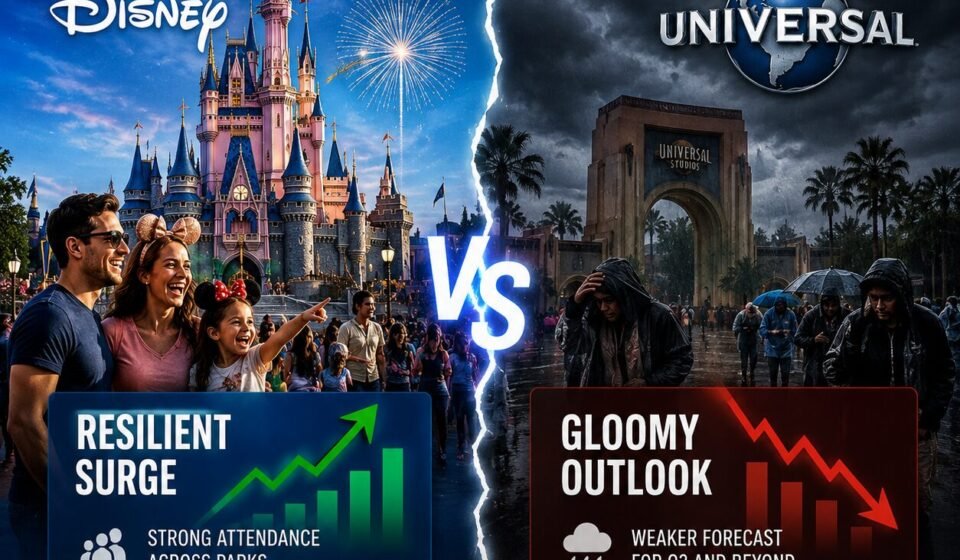
The Great Theme Park Divide: Disney’s Resilient Surge Contrasts With Universal’s Gloomy Outlook

BURBANK, CA : Theme parks have long served as the ultimate barometer for consumer health and discretionary spending. When families feel squeezed by inflation or economic uncertainty, multi-thousand-dollar vacation packages are often the first items trimmed from household budgets. However, the latest quarterly earnings reports from corporate rivals The Walt Disney Company and Comcast’s Universal Destinations & Experiences present two strikingly divergent narratives about the state of the American consumer.
While Comcast recently painted a muted picture for Universal’s park attendance—pointing to softening consumer demand and a cautious public—Disney delivered a blowout performance for its fiscal third quarter. Bolstered by a sharp rebound in domestic park attendance, robust guest spending, and expanding cruise operations, Disney’s domestic parks and experiences revenue surged 11 percent year-over-year.
The contrasting fortunes illuminate a shifting landscape in Central Florida and Southern California: while consumers may indeed be tightening their belts, they are becoming increasingly selective about where they spend their vacation dollars—and Disney’s aggressive promotional strategy and closed-ecosystem model appear to be winning the day.
Inside the Numbers: Disney’s Standout Quarter
Disney’s Experiences division—which encompasses its six global theme park resorts, Disney Cruise Line, consumer products, and gaming licenses—posted record-setting results for the three months ended late June.
-
Overall Segment Revenue: Reached $9.97 billion, representing a 10 per cent increase compared to $9.09 billion during the same period in the prior year.
-
Domestic Parks & Experiences Revenue: Rose 11 per cent year-over-year to $7.12 billion.
-
Operating Income: Climbed 20 per cent across the division to $3.02 billion, up from $2.52 billion a year earlier. The domestic division drove the bulk of this gain, jumping 27 per cent to $2.09 billion.
-
Attendance & Per-Capita Spending: Domestic park attendance grew by 3 per cent, while per-capita guest spending at U.S. parks expanded by 4 per cent.
+-----------------------------------------------------------------------------------+
|                        DISNEY Q3 EXPERIENCES FINANCIAL SUMMARY                    |
+-----------------------------------+--------------------+--------------------------+
| Financial / Operational Metric    | Q3 Performance     | Year-Over-Year Change    |
+-----------------------------------+--------------------+--------------------------+
| Total Segment Revenue             | $9.97 Billion      | +10%                     |
| Domestic Parks & Experiences Rev  | $7.12 Billion      | +11%                     |
| Total Operating Income            | $3.02 Billion      | +20%                     |
| Domestic Attendance               | --                 | +3%                      |
| Domestic Per Capita Spending      | --                 | +4%                      |
| Resorts & Vacation Revenue        | --                 | +17%                     |
+-----------------------------------+--------------------+--------------------------+
The standout gains came despite broader headwinds facing the U.S. tourism sector, including a noticeable drop in inbound international visitors. Disney’s leadership credited strong domestic resort occupancy, higher average ticket yields, and an expanding fleet of cruise ships for offsetting softness in international markets.
“Domestically, we are doing extremely well right now,” Disney Chief Financial Officer Hugh Johnston stated, highlighting that summer room bookings and passholder turnstile numbers significantly exceeded early internal forecasts.
Universal’s Lull: The Pre-Epic Universe Slump
Disney’s stellar performance stands in stark contrast to the commentary provided by Comcast executives during Universal’s recent earnings call. Universal Destinations & Experiences reported flat-to-declining attendance across its domestic resorts in Orlando and Hollywood, citing a broader normalization in post-pandemic leisure travel and heightened cost sensitivity among middle-income families.
Industry analysts point to three primary drivers behind Universal’s current softness relative to Disney:
-
The “Epic Universe” Delay Effect: Universal is currently building Epic Universe, a massive new multi-billion-dollar theme park in Orlando. Many potential guests are choosing to postpone their Central Florida vacations until the new gate officially opens, leading to a temporary lull at Universal Studios Florida and Islands of Adventure.
-
Ecosystem Depth: Disney benefits from a massive, closed vacation ecosystem in Orlando. With over 25 resort hotels, four theme parks, two water parks, and the Disney Springs shopping district, Disney is uniquely capable of capturing 100 percent of a guest’s vacation budget over a five-to-seven-day stay.
-
Targeted Discounting Agility: When consumer demand fluctuates, Disney has historically moved quicker to roll out strategic promotions, such as discounted multi-day tickets and room offers for annual passholders and Disney+ subscribers, helping shore up occupancy during slow windows.
While Universal’s long-term outlook remains bright once Epic Universe opens its turnstiles, its short-term financial trajectory has felt the brunt of consumer pullbacks far more sharply than its Burbank-based competitor.
Theme Parks as an Economic Indicator
For decades, economists have monitored theme park attendance as a gauge of consumer discretionary appetite. Unlike essential expenditures like housing or groceries, theme park visits represent purely elective spending.
In previous inflationary cycles, soaring ticket prices and elevated hotel rates forced cost-conscious families to trade down to regional amusement parks or opt for staycations. Yet Disney’s ability to drive a 4 percent increase in per-capita spending alongside a 3 percent attendance gain suggests that high-income consumers remain resilient, while middle-income travelers are choosing premium brand experiences when they do decide to spend.
Disney’s resorts and vacations sub-segment surged 17 percent during the quarter, driven heavily by its cruise division. The launch of new vessels like the Disney Treasure added significant passenger capacity, proving that experiential travel continues to command strong pricing power even as retail consumer confidence fluctuates.
+-----------------------------------------------------------------------------------+
|                  DISNEY VS. UNIVERSAL: COMPARATIVE PERFORMANCE                    |
+-----------------------------------+-----------------------+-----------------------+
| Strategic Dimension               | Disney Parks          | Universal Parks       |
+-----------------------------------+-----------------------+-----------------------+
| Recent Revenue Trend              | Up 11% (Domestic)     | Flat to Soft          |
| Key Growth Driver                 | Cruises & U.S. Parks  | International Parks   |
| Promotional Strategy              | Dynamic Discounting   | Standard Pricing      |
| Core Ecosystem Advantage          | Multi-Park Capture    | Thrill Attractions    |
| Upcoming Major Expansion          | Magic Kingdom Lands   | Epic Universe         |
+-----------------------------------+-----------------------+-----------------------+
Strategic Drivers Behind Disney’s Outperformance
Several structural factors explain why Disney managed to decouple from the broader leisure travel slowdown that impacted Universal:
1. Strategic Summer Discounting
Recognizing early in the year that domestic consumers were feeling the pinch of sustained inflation, Disney introduced targeted ticket packages—such as the 4-Day, 4-Park Magic Ticket—which effectively lowered the per-day cost for families willing to visit all four Orlando parks. This drove higher volume that translated into increased high-margin food, beverage, and merchandise sales.
2. Disney Cruise Line Expansion
The Disney Cruise Line has become one of the most profitable engines within the Experiences segment. With passenger cruise days increasing by 10 percent year-over-year, the cruise fleet generated premium yields that insulated the company from localized dips in Central Florida tourism.
3. Content Integration
The release of summer box-office successes like Toy Story 5 refreshed character demand across the parks. Meet-and-greets, themed food items, and exclusive merchandise tied to active theatrical releases helped maintain park relevance among family demographics.
Looking Ahead to the Central Florida Battleground
As the fiscal year enters its final quarter, the rivalry between Disney and Universal is set to reach unprecedented levels. Disney has signalled that forward bookings for its domestic parks and cruise lines remain solid, though it expects international inbound travel to remain subdued through the end of the year.
Meanwhile, Universal is banking heavily on the upcoming debut of Epic Universe to completely reshape the Central Florida market dynamic. When completed, the new park will add Nintendo, Harry Potter, and Classic Monsters-themed lands, creating a true multi-day destination capable of challenging Disney’s market dominance.
For now, however, Disney’s latest earnings report sends a clear signal to Wall Street: despite economic headwinds and a cautious consumer base, the magic kingdom remains remarkably adept at turning fairy tales into financial strength.