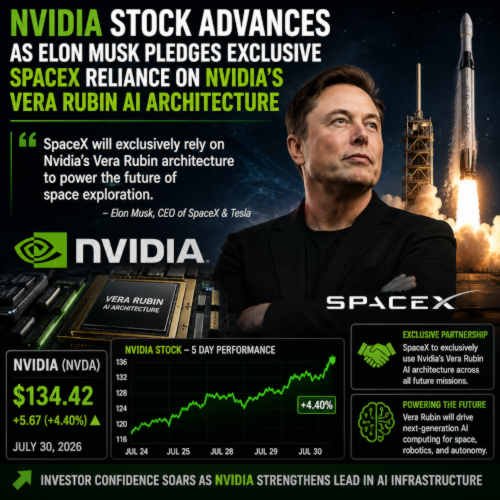
Nvidia Stock Advances as Elon Musk Pledges Exclusive SpaceX Reliance on Nvidia’s Vera Rubin AI Architecture

SAN FRANCISCO, CA — Shares of semiconductor giant Nvidia Corporation (NASDAQ: NVDA) trended higher on Wednesday following a high-profile endorsement from SpaceX Chief Executive Officer Elon Musk. Speaking during SpaceX’s inaugural earnings call as a public entity, Musk announced that the aerospace and defence company will rely exclusively on Nvidia’s next-generation artificial intelligence hardware for both its terrestrial data centres and its ambitious orbital computing network.
The explicit commitment centred around Nvidia’s newly unveiled Vera Rubin architecture provided an immediate lift to Nvidia stock, which gained over 2.5% in extended and morning trading. The announcement underscores Nvidia’s continued stronghold over the high-performance AI chip market, even as mega-cap technology firms and aerospace competitors attempt to develop proprietary custom silicon.
“Going forward, we have decided to build exclusively on Nvidia, because we think the Vera Rubin architecture is the best architecture,” Musk stated during the call. “We think it is the best AI computer, and we greatly value our close cooperation and partnership on many levels with Nvidia. We are exclusive to Nvidia.”
The Technical Edge: Why SpaceX Selected the Vera Rubin Architecture
Musk’s decision to standardise SpaceX’s global and orbital compute infrastructure on Nvidia comes down to compute density, thermal management, and interconnect efficiency. In particular, Musk highlighted Nvidia’s Vera Rubin NVL72 rack-scale architecture, which eliminates complex external manual cabling and liquid-cooling hoses in favor of backplane connectivity.
+-----------------------------------------------------------------------------------+
|                     NVIDIA VERA RUBIN VS. LEGACY ARCHITECTURES                    |
+-------------------+-----------------------------------+---------------------------+
| Feature           | Nvidia Vera Rubin NVL72           | Traditional AI Racks      |
+-------------------+-----------------------------------+---------------------------+
| Interconnect      | Cable-less blind-mate backplane   | Manual fiber & copper     |
| Compute Density   | Integrated Vera CPU + Rubin GPU   | Discrete CPU/GPU slots    |
| Serviceability    | Modular tray-level swapping       | Complex cable routing     |
| Deployment Focus  | Terrestrial & Orbital Payloads    | Standard Data Centers     |
+-------------------+-----------------------------------+---------------------------+
For a company operating in extreme environments—ranging from rocket launch facilities to radiation-heavy low Earth orbit (LEO)—hardware reliability and modular serviceability are critical factors.
“We think the design of the NVL72 VR[200] computer is a much better design than, say, having a standard rack-style design,” Musk explained on the call, emphasising that the reduction in physical connection points directly translates to lower failure rates during launch vibration and thermal cycling.
SpaceX Financial Results Context: AI Segment Surges 247%
The exclusivity announcement arrived during SpaceX’s (NYSE: SPCX) second-quarter earnings presentation—its first financial release since completing its record-setting initial public offering. While SpaceX shares experienced volatility following the report due to an upcoming insider lockup expiration, the company’s underlying operating metrics demonstrated significant scale across satellite internet, launch services, and artificial intelligence infrastructure.
+-----------------------------------------------------------------------------------+
|                        SPACEX Q2 FINANCIAL & OPERATIONAL HIGHLIGHTS               |
+-----------------------------------+--------------------+--------------------------+
| Metric / Segment                  | Q2 Result          | YoY Growth / Context     |
+-----------------------------------+--------------------+--------------------------+
| Total Consolidated Revenue        | $7.80 Billion      | +92% YoY                 |
| Connectivity (Starlink) Revenue   | $4.29 Billion      | +66% YoY ($1.66B Op Inc) |
| AI & Supercomputing Revenue       | $2.56 Billion      | +247% YoY                |
| Starlink Active Subscribers       | 12.0 Million       | Doubled YoY (167 Ctrys)  |
| Total Orbital Mass Delivered      | 1,041 Tons         | 78 Successful Launches   |
+-----------------------------------+--------------------+--------------------------+
Source: SpaceX Q2 Earnings Release & Financial Filing
SpaceX’s AI segment generated $2.56 billion in second-quarter revenue, fueled by enterprise cloud compute agreements with xAI and commercial partners. The commercial integration between xAI’s Grok models—including the upcoming Grok 5 release—and SpaceX’s vast operational dataset requires massive hardware throughput, which will now be funneled directly into Nvidia’s supply pipeline.
From Ground to Low Earth Orbit: The Starmind AI1 Satellite Fleet
A key highlight for semiconductor analysts was SpaceX’s announcement of the Starmind AI1 satellite program, co-developed alongside Nvidia’s engineering team.
Rather than relying purely on ground-based data centers that face power-grid constraints, SpaceX plans to launch radiation-shielded orbital data centers equipped with specialized Vera Rubin payloads.
+-----------------------------------------------------------------------------------+
|                     STARMIND AI1 SATELLITE COMPUTE ARCHITECTURE                   |
+-----------------------------------+-----------------------------------------------+
| Component                         | Operational Role                              |
+-----------------------------------+-----------------------------------------------+
| Nvidia Rubin GPUs                 | Parallel AI inferencing and model processing  |
| Nvidia Vera CPUs                  | High-efficiency host management and routing   |
| Direct Optical Inter-Satellite    | Multi-terabit data meshing in orbit           |
| Orbital Solar Array Integration   | Direct solar energy capture (zero grid dependency)|
+-----------------------------------+-----------------------------------------------+
The first batch of Starmind satellites is scheduled to begin launching next year. By deploying Nvidia’s hardware into orbit, SpaceX aims to deliver low-latency, space-based AI compute capabilities to commercial enterprises, defense agencies, and autonomous aviation systems globally.
Target 15 Gigawatts: Scaling Infrastructure and Cooling
Beyond hardware selection, Musk laid out an aggressive infrastructure roadmap for SpaceX’s compute footprint. The company targets expanding its online AI compute capacity from over 2 gigawatts by the end of this year to 10 gigawatts by late 2027, eventually topping 15 gigawatts.
Musk emphasised that the primary bottleneck facing mega-scale AI deployments is no longer GPU supply alone, but rather power distribution and thermal dissipation.
“The bottleneck is shifting rapidly from pure silicon delivery to power generation, high-voltage transformers, and liquid cooling systems,” Musk noted. By optimising the Vera Rubin NVL72 platform specifically for extreme liquid-cooling efficiency, Nvidia has positioned itself as the preferred vendor for hyperscalers and specialised aerospace operators seeking to overcome thermal throttling.
Wall Street Impact and Semiconductor Market Outlook
Nvidia stock has spent much of the year consolidating after a multi-year rally, with institutional investors closely monitoring whether competing chipmakers—such as Advanced Micro Devices (AMD)—or custom ASIC developments would erode Nvidia’s market share.
Musk’s explicit endorsement acts as a major vote of confidence in Nvidia’s CUDA software ecosystem and hardware architecture, effectively shutting out competing merchant silicon for one of the world’s fastest-growing AI compute consumers.
+-----------------------------------------------------------------------------------+
|                        WALL STREET VALUATION METRICS: NVIDIA (NVDA)               |
+-----------------------------------+-----------------------------------------------+
| Metric                            | Current Valuation / Level                     |
+-----------------------------------+-----------------------------------------------+
| Forward Price-to-Earnings (P/E)   | ~24.0x (Historical Discount Range)            |
| Market Capitalization             | ~$3.10 Trillion                               |
| Consensus Analyst Rating          | Strong Buy (Average Target: $175.00)          |
| Key Catalyst                      | Vera Rubin Architecture & Space Compute Scale |
+-----------------------------------+-----------------------------------------------+
Source: LSEG Financial / Market Data
Financial analysts pointed out that Nvidia’s stock trading at under 24 times forward earnings represents an attractive entry point given its high operating margins and locked-in demand pipeline. With SpaceX committing billions in future hardware orders for both ground supercomputers and space payloads, Nvidia reinforces its position as the foundational engine of the global artificial intelligence boom.