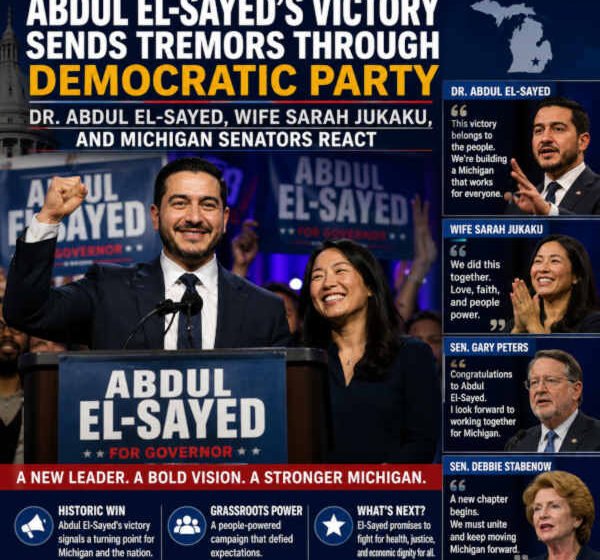
Abdul El-Sayed’s Victory Sends Tremors Through Democratic Party: Dr. Abdul El-Sayed, Wife Sarah Jukaku, and Michigan Senators React

DETROIT, MI: Dr Abdul El-Sayed’s victory over U.S. Representative Haley Stevens in Michigan’s Democratic Senate primary has sent shockwaves through the national political landscape. By tapping into grassroots progressive momentum and capitalising on deep intra-party divides over foreign policy and economic reform, the former physician, county health director, and university professor secured the nomination in a high-stakes bellwether three months before the pivotal midterm elections.
El-Sayed’s triumph—built “brick by brick,” as he declared alongside his wife, Dr Sarah Jukaku, during his victory speech in Detroit highlights a changing tide within the Democratic coalition. In a critical battleground state where establishment figures have long favoured moderate candidates, primary voters opted instead for a progressive insurgent. The result caps off a primary night across five states that revealed an electorate fraught with tension, where foreign policy fractures, working-class populism, and ideological polarisation are actively reshaping both major political parties.
The Anatomy of an Upset: How Dr Abdul El-Sayed and Sarah Jukaku Mobilised Michigan
While national observers viewed the primary as a toss-up entering the final weeks, local polling and grassroots organising efforts steadily favoured Dr Abdul El-Sayed over Stevens, a three-term congresswoman backed by party leadership, labour PACs, and traditional advocacy groups.
Throughout the gruelling campaign, Dr El-Sayed’s wife, psychiatrist Sarah Jukaku, played a central role, helping navigate intense political attacks while grounding his campaign’s focus on mental health, community wellness, and family advocacy. El-Sayed constructed a multi-generational, racially diverse coalition. His campaign mobilised young voters across college campuses in Ann Arbour and East Lansing, aligned with labour halls in Metro Detroit, and energised Michigan’s substantial Arab American and Muslim American communities.
+------------------------------------------------------------------------------------+
|                      MICHIGAN DEMOCRATIC SENATE PRIMARY OVERVIEW                   |
+----------------------+---------------------------+---------------------------------+
| Candidate            | Primary Platform Focus    | Core Support Base               |
+----------------------+---------------------------+---------------------------------+
| Dr. Abdul El-Sayed   | Medicare for All, Gaza    | Progressive Youth, Arab American|
| (Winner)             | Ceasefire, Labor Rights   | Coalition, Grassroots Donors    |
+----------------------+---------------------------+---------------------------------+
| Rep. Haley Stevens   | Mainstream Democratic     | Establishment Leadership, Main  |
|                      | Agenda, Pro-Israel Policy | Street Business, Traditional PACs|
+----------------------+---------------------------+---------------------------------+
Key factors driving Abdul Sayed’s campaign included:
-
Universal Healthcare and Economic Populism: Grounding his platform in his background as a physician and public health officer, Dr El-Sayed campaigned heavily on healthcare access, single-payer systems, and strict corporate accountability.
-
Grassroots Small-Dollar Funding: Rejecting corporate PAC contributions, his campaign relied on individual donations, building an active field operation that out-canvassed the competition across urban and suburban districts alike.
-
Foreign Policy and Gaza Backlash: El-Sayed directly channelled voter frustration regarding federal policy in the Middle East, mobilising voters who demanded a shift in U.S. foreign policy.
Pro-Israel Candidates Face Rising Vulnerability in Democratic Primaries
Beyond the immediate dynamics in Michigan, Tuesday night’s primary outcomes underscored a broader structural shift: established candidates backed by traditional pro-Israel advocacy groups face heightened political risk in Democratic primaries.
For years, organisations like the American Israel Public Affairs Committee (AIPAC) and its political action arm, United Democracy Project (UDP), exerted formidable influence by pouring millions into television advertising to protect moderate incumbents or friendly open-seat candidates. However, the political fallout from ongoing conflicts in the Middle East has mobilised progressive activist networks to actively counter this financial advantage.
In Michigan, Representative Haley Stevens faced sustained criticism from the left for her aligned record with mainstream foreign policy organisations. Dr Abdul El-Sayed’s ability to withstand major independent expenditure campaigns against him demonstrates that strong ground-level organising and clear ideological contrast can neutralise traditional spending imbalances.
The Republican Landscape: Donald Trump’s Primary Grip Holds Firm
While Democrats navigate internal ideological rifts, Tuesday’s primary results across the five participating states reinforced Donald Trump’s continued dominance over the Republican primary process.
Across high-profile Senate, House, and gubernatorial contests, candidates backed by the former president swept their respective races, defeating traditional conservative contenders who sought to chart an independent course.
+------------------------------------------------------------------------------------+
|                         PRIMARY NIGHT KEY TAKEAWAYS BY PARTY                        |
+-----------------------------------+------------------------------------------------+
| Party                             | Primary Night Dynamics & Trends                |
+-----------------------------------+------------------------------------------------+
| Democratic Party                  | • Progressive insurgency triumphs over status  |
|                                   |   quo candidates in key battlegrounds.         |
|                                   | • Foreign policy litmus tests increase risk   |
|                                   |   for moderate, pro-Israel incumbents.         |
+-----------------------------------+------------------------------------------------+
| Republican Party                  | • Trump endorsements remain the decisive factor|
|                                   |   in contested GOP primaries.                  |
|                                   | • Grassroots MAGA alignment continues to out-  |
|                                   |   perform traditional donor-class picks.       |
+-----------------------------------+------------------------------------------------+
In Michigan, former Representative Mike Rogers captured the GOP nomination to set up a clash with Dr. El-Sayed for the seat held by retiring Democratic Senator Gary Peters. Trump’s primary endorsements continue to serve as the definitive kingmaker in GOP politics, setting up a general election where party bases diverge sharply.
Four Key Takeaways from Tuesday’s Five-State Primaries
The results across Tuesday’s primary slate offer a clear snapshot of the American electorate three months before voters determine control of Capitol Hill and key governor’s mansions:
-
The Progressive Left Retains Sharp Momentum: Dr Abdul El-Sayed’s victory proves that progressive movement leaders can win statewide nominations in competitive Rust Belt battlegrounds when backed by organised field movements.
-
Foreign Policy Fractures Are Redefining Coalitions: The vulnerability of candidates backed by traditional political action committees highlights growing divergence between base voters and party leadership.
-
The GOP Primary Remains Monolithic: Donald Trump’s endorsement remains a powerful currency in Republican politics, virtually guaranteeing primary success for aligned candidates.
-
Michigan Senators Race Sets Up General Election Clash: Current Michigan senators and national party leaders are preparing for a general election contest between Dr. Abdul El-Sayed and Republican Mike Rogers that will test whether a progressive populist platform can carry a purple swing state.
Looking Ahead to November: High Stakes in the Great Lakes State
With the primary concluded, the focus swiftly pivots to the November general election, where control of the U.S. Senate could hinge entirely on Michigan’s open seat.
National Republican strategists have already signalled plans to frame Dr El-Sayed’s progressive platform as out of step with general election voters in moderate suburban counties. Conversely, Dr Abdul El-Sayed and his wife, Sarah Jukaku, joined supporters in arguing that his populist message on healthcare, wages, and corporate accountability offers a compelling alternative capable of expanding the electorate by bringing historically overlooked working-class and non-voter demographics to the polls.