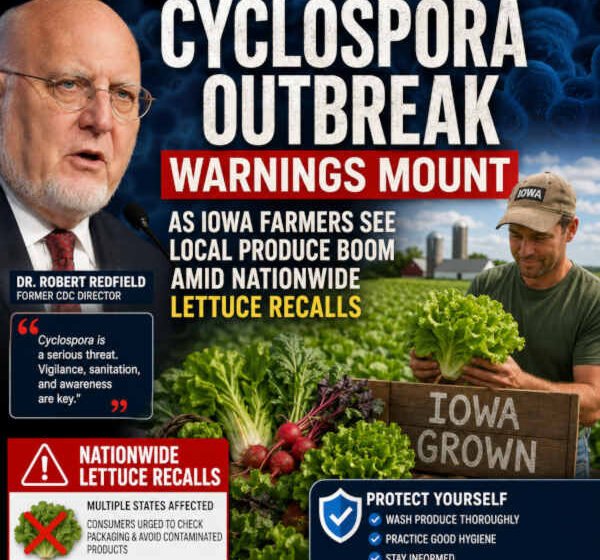
Dr. Robert Redfield Cyclospora Outbreak Warnings Mount as Iowa Farmers See Local Produce Boom Amid Nationwide Lettuce Recalls

DES MOINES, Iowa: An expanding multistate outbreak of Cyclospora infections has sent shockwaves through America’s agricultural supply chain, triggering widespread lettuce recalls, sickening thousands of consumers, and igniting an urgent national conversation surrounding food safety, public health surveillance, and local food sovereignty.
As federal health authorities track nearly 12,000 reported cases of cyclosporiasis across the United States, former Centres for Disease Control and Prevention (CDC) Director Dr Robert Redfield has issued public warnings regarding the challenges of early outbreak detection and the critical importance of robust disease surveillance. Meanwhile, on the ground in Des Moines, Iowa, local farmers are experiencing an unexpected economic ripple effect: frightened consumers are turning away from industrial grocery store produce in favour of locally grown crops.
The Nationwide Crisis and Dr Robert Redfield’s Surveillance Warnings
The Cyclospora cayetanensis parasite—a microscopic pathogen that causes severe gastrointestinal illness known as cyclosporiasis—has spread rapidly across more than a dozen states during the summer months. The disease is typically transmitted through food or water contaminated with faecal matter, with fresh produce such as packaged salad greens, leafy lettuce, and herbs serving as common vehicles for transmission.
Appearing on national news broadcasts to address the growing crisis, former CDC Director Dr Robert Redfield emphasised that identifying a single produce supplier or recall may not immediately halt the spread of infections.
“If we see no new cases, then we found the only source,” Dr. Redfield noted during an interview with NewsNation’s Elizabeth Vargas. “If we continue to see new cases, there could easily be other sources that we need to identify.”
Dr Redfield also highlighted structural concerns regarding disease surveillance. With federal adjustments to national public health monitoring networks like FoodNet, fewer pathogens are receiving automatic, comprehensive real-time tracking across all states.
“I don’t think it’s in our country’s interest to cut these programs back,” Dr Redfield cautioned, pointing out that strong surveillance infrastructure is essential for early cluster detection before outbreaks expand to thousands of victims. Because the incubation period for Cyclospora can range from several days to two weeks after ingestion, infected individuals often do not connect their symptoms to produce consumed weeks prior, complicating epidemiological contact tracing.
Iowa State Breakdown: Rising Infection Counts and Local Market Impact
In Iowa, which was added to the CDC’s list of heavily impacted states, public health agencies have logged a sharp surge in laboratory-confirmed cases. According to data released by the Iowa Department of Health and Human Services, Iowa recorded 226 lab-confirmed infections across 48 counties, compared to just 69 total cases during the same period in the previous year.
Polk County, Iowa’s most populous county, has emerged as a central focal point for local health officials. Addie Olson, spokesperson for the Polk County Health Department, confirmed 36 positive cases within the county alone.
“About two-thirds of those local cases were domestically acquired right here in Iowa, while roughly one-third were linked to international travel,” Olson stated. While public health investigators cannot pinpoint the exact origin of every individual case, health agencies have explicitly linked local cases to nationwide recalls of lettuce packaged by California-based produce giant Taylor Farms.
Local Farmers Market Surge: Grade A Gardens Sees Unprecedented Demand
While industrial produce recalls have created anxiety among grocery shoppers, small-scale local growers in Iowa are experiencing a record-setting surge in sales.
At the Downtown Des Moines Farmers’ Market, Jordan Clasen, co-owner of Grade A Gardens, reported his biggest sales weekend of the entire year. Clasen, who operates a 30-acre organic produce farm in Earlham, Iowa, alongside his wife Whitney, attributes the sudden influx of customers directly to consumer fears over contaminated commercial lettuce.
“I am getting a lot of people asking if we have lettuce,” Clasen explained. “I hate turning people away, but I just simply don’t have it right now.”
The situation underscores a classic seasonal paradox for Midwest agriculture. While consumer demand for leafy greens is soaring due to the recalls, high summer temperatures mean that cool-weather crops like head lettuce are currently out of season in Iowa.
Despite the lack of fresh lettuce, Clasen views the outbreak as an educational milestone for the community. “While the outbreak is unfortunate, it’s also been an educational moment for people to learn where their food is sourced,” Clasen noted. He encourages shoppers to embrace what is naturally ripe during Iowa’s mid-summer harvest—what he calls the “rainbow of the season”—including fresh sweet corn, heirloom tomatoes, green beans, cooking greens, and okra.
The Iowa Food Paradox: World-Class Soil, Imported Produce
The Cyclospora outbreak has brought renewed scrutiny to Iowa’s agricultural supply chain. Despite boasting some of the most fertile topsoil in the world, research from the Leopold Centre for Sustainable Agriculture at Iowa State University reveals a striking statistic: 90% of the food consumed by Iowans is imported from outside the state.
Multi-billion-dollar commercial agricultural corporations, such as Taylor Farms, dominate the national grocery market. Taylor Farms alone generates over $7 billion in annual produce sales, cultivating crops across massive acreage in California, Arizona, Mexico, and Canada. When a contamination incident occurs at a centralised processing or washing facility within these massive supply networks, the resulting recall ripples across dozens of states simultaneously.
By contrast, regional farm networks provide shorter supply chains with fewer handling touchpoints, drastically reducing the risk of widespread, multi-state bacterial or parasitic contamination.
Related Health, Legal, and National News
For more coverage on health alerts, product recalls, legal rights, and trending news, explore our latest articles:
Symptoms, Treatment, and Consumer Safety Measures
Medical professionals urge consumers to remain vigilant for symptoms of cyclosporiasis, especially if they have recently consumed pre-packaged salad mixes or fresh produce.
Common Symptoms of Cyclosporiasis:
-
Watery, explosive diarrhoea (lasting from several days to weeks if untreated)
-
Severe abdominal cramping, gas, and bloating
-
Nausea, loss of appetite, and sudden weight loss
-
Low-grade fever and fatigue
Unlike common bacterial food poisoning caused by Salmonella or E. coli, Cyclospora is a microscopic parasite. Standard antibiotics like penicillin or amoxicillin are ineffective against it; treatment typically requires a specific regimen of trimethoprim-sulfamethoxazole (Bactrim).
Recommended Safety Steps for Produce:
-
Check Recall Notices: Immediately discard any packaged salads, romaine, or green leaf lettuce associated with recent Taylor Farms or retailer-specific recalls.
-
Wash Thoroughly: Wash all fresh fruits and vegetables under cold running water before eating, cutting, or cooking. (Note: While washing reduces risk, Cyclospora can stick tightly to produce surfaces, making prevention at the farm source critical.
-
Support Local Seasonal Markets: Purchasing directly from local farmers provides transparency regarding growing and harvesting conditions.
Conclusion: Rebuilding Trust in the Food Supply
As federal agencies work alongside state health departments to trace lingering infection clusters, Dr Robert Redfield’s commentary serves as a stark reminder that public health vigilance must remain a national priority. For Iowans, the current Cyclospora outbreak is transforming consumer buying habits, shifting focus toward seasonal, locally grown crops, and highlighting the vital role of local farming in building a resilient, safe food system.
For a deeper dive into expert commentary on the national spread of this parasite, watch Dr Robert Redfield discuss the nationwide Cyclospora outbreak on NewsNation. This video provides essential expert analysis from the former CDC director on how the parasite spreads and why surveillance remains vital to public health safety.