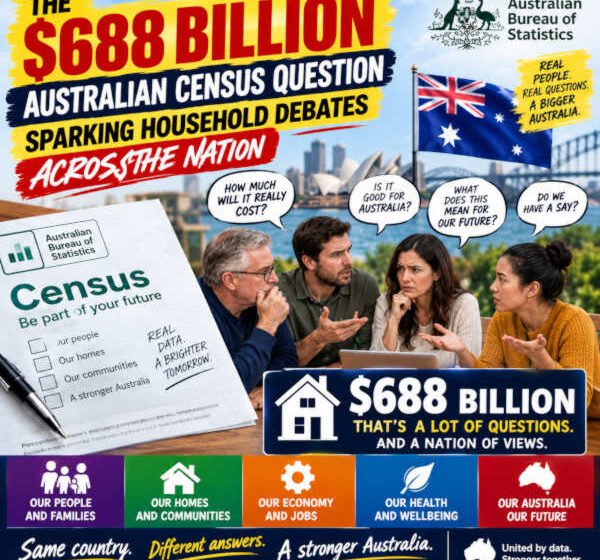
The $688 Billion Australian Census Question Sparking Household Debates Across the Nation

Australia News Today: As millions of households log on to complete their census form on Census night, a single question about unpaid domestic work is igniting debates across living rooms and social media feeds.
The question—which asks respondents to quantify the time spent over the past week on unpaid domestic labour such as cooking, cleaning, laundry, grocery shopping, and household financial management—appears simple on the surface. However, its implications touch upon gender equality, economic visibility, and domestic relationship dynamics across Census Australia.
The $688 Billion Question on the Australian Census Form
Question 52 on the Australian census form asks: “In the last week, did the person spend time doing unpaid domestic work for their household?” Options range from zero hours to less than five, up to more than 30 hours per week.
While the question aims to collect crucial statistical data for the Australian Bureau of Statistics (ABS), social media platforms like TikTok, Instagram, and Reddit have exploded with commentary from couples comparing notes—and often disagreeing on their respective contributions.
Question 52: Unpaid Domestic Work Options
├── No unpaid domestic work
├── Less than 5 hours
├── 5 to 14 hours
├── 15 to 29 hours
└── 30 hours or more
The True Economic Value of Unpaid Labour
Research led by Dr Leonora Risse, an associate professor in economics specialising in gender equality, reveals that unpaid domestic labor contributes an estimated $688 billion annually to the national economy. That represents approximately one-third of Australia’s Gross Domestic Product (GDP).
Total Value of Australian Unpaid Labour: $688 Billion / Year
┌──────────────────────────────────────┬──────────────────────────────────┐
│ Female Contribution ($427.3 Billion)  │ Male Contribution ($260.7B)      │
└──────────────────────────────────────┴──────────────────────────────────┘
Women perform the vast majority of this unseen work, contributing $427.3 billion annually compared to $260.7 billion performed by men
Gender Disparity in Australian Households
Data from previous surveys conducted by the ABS census team demonstrates a persistent gender gap in domestic responsibilities. On average, Australian women devote nearly four hours a day to unpaid household chores and caregiving, while men average roughly two and a half hours.
| Metric | Women | Men |
| Average Daily Unpaid Work | ~3.8 Hours | ~2.5 Hours |
| Annual Unpaid Work Economic Value | ~$40,000 / person | ~$24,000 / person |
| Share of Unpaid National Labour | 62.1% | 37.9% |
| Share of Paid Labour Force Hours | 36.8% | 63.2% |
| Adjusted Total Work Share (Paid + Unpaid) | 50.5% | 49.5% |
When paid employment and unpaid domestic work are combined and adjusted for female-dominated job market undervaluation, women perform roughly 50.5% of all total labour in Australia, yet receive market compensation for far less of it compared to men.
Essential Information for Census Night 2026
For those preparing their submission on census day, here is key administrative guidance regarding the 2026 census:
-
When is Census Night? Census night officially takes place on Tuesday, 11 August 2026.
-
Where to Complete: Access your census form online at census.abs.gov.au or fill out the official paper Australia census form mailed to your address.
-
Who Must Be Included: Every person present in your household on census night, including international visitors and temporary residents.
-
Legal Obligation: Under the Census and Statistics Act 1905, completing the abs census 2026 is mandatory for all residents in Australia.
-
When Was the Last Census in Australia? The previous nationwide enumeration took place five years ago on 10 August 2021.
Why the ABS Asks About Unpaid Work
The Australian Bureau of Statistics uses answers from census questions regarding unpaid work, caregiving, and voluntary work to guide policy, funding allocations, and infrastructure planning across federal, state, and local governments.
Policy Impact Areas
-
Childcare & Early Education Funding: Allocating resources to regions with high demands for unpaid childcare.
-
Aged Care & Disability Support Services: Identifying communities relying heavily on informal, unpaid family caregiving.
-
Public Transport & Urban Infrastructure: Planning transit routes that support non-traditional work commuting patterns, such as school drop-offs and errands.
-
Gender Pay Gap & Superannuation Reform: Providing statistical evidence to address superannuation disparities caused by career breaks for unpaid domestic labour.
Frequently Asked Questions (FAQ)
How do I log into the census online?
Visit the official portal at census.abs.gov.au. You will need the unique 12-digit Census Number and temporary password provided in the official letter delivered to your dwelling by the ABS.
What if I am away from home on Census Night?
If you are travelling within Australia on census night, you must be recorded on the Australian census form at the location where you are staying on that night (e.g., hotel, friend’s residence, or holiday rental).
Should I count routine maintenance and yard work as domestic work?
Yes. The ABS census 2026 instructions clarify that unpaid domestic work includes routine housework, cooking, home maintenance, gardening, yard work, shopping, and household financial management.
The Broader Social Impact
As Australians complete the Census 2026 survey, experts hope the conversation extends beyond lighthearted household debate to meaningful policy discussion.
Recognising unpaid labour in national datasets ensures that the vital work keeping households, families, and communities functioning is measured, valued, and factored into the nation’s economic future.