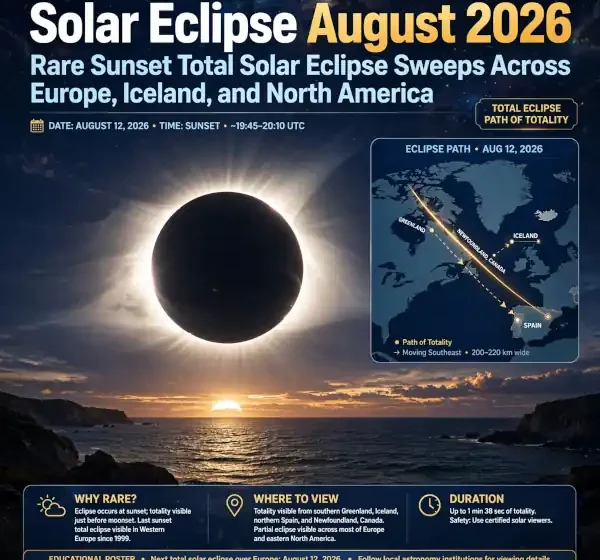
Solar Eclipse August 2026: Rare Sunset Total Solar Eclipse Sweeps Across Europe, Iceland, and North America

MADISON, Wis. : Skywatchers, astronomers, and millions of stargazers across the Northern Hemisphere are turning their eyes toward the heavens today as one of the most magnificent astronomical events of the decade unfolds. The August 12, 2026 total solar eclipse is delivering a dramatic, rare sunset celestial spectacle over parts of Europe, Greenland, and Iceland, while casting a widespread partial eclipse over the northern United States, Canada, and Africa.
This stunning cosmic display marks the first total solar eclipse visible from mainland Europe since 1999. For observers along the narrow path of totality, the Moon will pass directly between the Earth and the Sun, completely blocking solar rays and plunging daytime landscapes into a ghostly, twilight darkness.
What Time Is the Solar Eclipse on August 12, 2026?
The timing of today’s eclipse depends heavily on geographic location as the Moon’s deep central shadow—known as the umbra—sweeps across the Northern Hemisphere at thousands of miles per hour.
The journey begins in a remote, pristine stretch of northern Russia, where totality occurs near midday local time. The shadow then tracks eastward across eastern Greenland and western Iceland, reaching peak duration over the North Atlantic Ocean off Iceland’s western coast at approximately two minutes and 18 seconds.
In Iceland, locations such as Reykjavík and the Snæfellsnes peninsula experience totality during late afternoon. Later in the day, the path glides across the North Atlantic and makes landfall on the Iberian Peninsula, crossing northern Spain and a small slice of northeastern Portugal.
Timing and Path of Totality Key Highlights
| Location / Region | Type of Visibility | Peak Eclipse Time (Local Time) | Expected Duration of Totality |
| Northern Russia | Total Eclipse | Midday local time | ~1 min 50 sec |
| Western Iceland (Reykjavík/Snæfellsnes) | Total Eclipse | ~5:45 p.m. GMT | ~2 min 15 sec |
| León, Spain | Total Eclipse (Sunset) | 8:28 p.m. CEST | ~1 min 45 sec |
| Palma de Mallorca, Spain | Total Eclipse (Sunset) | 8:31 p.m. CEST | ~1 min 30 sec |
| Fairbanks, Alaska, USA | Partial Eclipse (37%) | 8:27 a.m. AKDT | N/A (Partial Only) |
| Augusta, Maine, USA | Partial Eclipse (21%) | 1:53 p.m. EDT | N/A (Partial Only) |
| London, United Kingdom | Partial Eclipse (91%) | 7:13 p.m. BST | N/A (Partial Only) |
The Magic of a Sunset Total Eclipse in Spain
For observers across northern and eastern Spain—including major cities like Bilbao, Zaragoza, León, Valencia, and the island of Mallorca—the August 12, 2026 event offers an exceptionally rare visual phenomenon: a total solar eclipse occurring directly against the backdrop of sunset.
In León, Spain, totality commences at 8:28 p.m. local time and concludes at 8:30 p.m. As the Sun sits low near the western horizon, the Moon fully covers the solar disk, revealing the Sun’s shimmering outer atmosphere—the solar corona—against a multi-hued twilight sky.
Dr. Ryan French, a solar astrophysicist at the Laboratory for Atmospheric and Space Physics in Boulder, Colorado, traveled to a viewing site north of Madrid to capture the event
Even as the complete dark phase concludes, partial eclipse phases linger until 9:22 p.m. local time in León, allowing viewers to watch a fiery crescent Sun dip beneath the European horizon.
What Happens Outside the Path of Totality?
While the narrow corridor of totality measures roughly 180 miles wide, millions of residents living far outside this path can still witness a impressive partial solar eclipse.
Partial Eclipse Across North America
In North America, the Moon’s outer shadow (the penumbra) grazes the northern United States and much of Canada:
-
Alaska & Northern Canada: Viewers in Fairbanks, Alaska, enjoy the deepest coverage in the U.S. at approximately 37% obstruction during morning hours.
-
New England & East Coast: Maine sees roughly 21% solar coverage at 1:53 p.m. EDT, while Boston sees 16%, New York City sees 10%, and Washington, D.C. observes a 4% partial bite.
-
Eastern Canada: Newfoundland and Labrador experience up to 53% solar coverage in the afternoon sky.
Partial Eclipse Across Europe and Africa
Across the United Kingdom, Ireland, continental Europe, and northwestern Africa, the partial eclipse is exceptionally deep:
-
United Kingdom: London witnesses 91% coverage, while southwest regions like Cornwall and Devon experience over 90% obscuration, darkening afternoon skies significantly.
-
Western Europe: Dublin reaches 94% coverage, and Paris hits 92%, giving urban dwellers a dramatic view of a thin solar crescent.
How to Watch Safely
Aviation agencies and eye health experts emphasise that solar safety is paramount during any eclipse event.
┌─────────────────────────────────────────────────────────────────────────┐
│                      SOLAR ECLIPSE EYE SAFETY GUIDE                     │
├─────────────────────────────────────────────────────────────────────────┤
│   PHASE OF ECLIPSE            │ REQUIRED PROTECTION                     │
├───────────────────────────────┼─────────────────────────────────────────┤
│  Partial Phases (Anytime)     │ Certified ISO 12312-2 Solar Glasses     │
│  Full Totality (1-2 Minutes)  │ Eye Protection May Be Briefly Removed   │
│  Telescopes / Binoculars      │ Front-Mounted Professional Solar Filters│
│  Regular Sunglasses           │ NEVER SUFFICIENT - CAUSES EYE DAMAGE    │
└─────────────────────────────────────────────────────────────────────────┘
-
Certified Eclipse Glasses: Viewers must use ISO 12312-2 compliant solar viewers at all times during partial phases. Standard sunglasses—no matter how dark—do not protect against retinal damage.
-
Camera and Lens Protection: Observing the Sun through cameras, binoculars, or telescopes without front-mounted solar filters can instantly destroy optical sensors and cause severe eye injury.
-
Indirect Viewing Methods: Pinhole projectors, card-stock cutouts, or household colanders pressed over white paper cast dozens of tiny crescent Sun shadows onto the ground, offering a safe alternative.
NASA and ESA Live Broadcasts
For global space enthusiasts residing outside the visibility zone, space agencies are providing high-definition live feeds:
-
NASA Live Broadcast: Starting at 1:15 p.m. ET on August 12, NASA’s official YouTube channel and website are streaming views from aircraft, ground observatories, and high-altitude balloons tracking the shadow.
-
European Space Agency (ESA): ESA’s livestream originates from the Observatorio Astrofísico de Javalambre in Teruel, Spain, featuring expert commentary from space scientists and multi-angle camera feeds from León and Frómista.
Double Feature: The Perseid Meteor Shower Peaks Tonight
Making the August 12, 2026 eclipse even more extraordinary is its celestial timing. Just hours after the Moon’s shadow lifts from the European continent, the annual Perseid Meteor Shower reaches its peak intensity between Wednesday night and Thursday morning.
Because the Moon is in its new phase during a solar eclipse, nighttime skies will be exceptionally dark. Stargazers situated in rural locations away from city light pollution can expect to see up to 60 to 100 fast, bright meteors per hour streaking across the sky.
NASA is extending its live astronomical coverage with a dedicated Perseid watch party beginning at midnight ET on August 13, giving night-sky enthusiasts a rare double-feature of cosmic wonders in a single 24-hour window.
Looking Ahead: When Is the Next Solar Eclipse?
While today’s August 12, 2026 total solar eclipse is a landmark event, Europe won’t have to wait long for its next major celestial spectacle:
-
August 2, 2027 Total Solar Eclipse: A remarkable total eclipse will cross southern Spain, Gibraltar, North Africa, and the Middle East, offering a staggering six minutes and 23 seconds of totality near Luxor, Egypt.
-
January 26, 2028 Annular Solar Eclipse: Spain will experience a “ring of fire” eclipse, completing an unprecedented trilogy of major solar eclipses visible from the Iberian Peninsula in consecutive years.
As today’s shadow races across oceans and continents, skywatchers around the globe are taking a moment to look up, safely enjoy the grandeur of orbital mechanics, and celebrate the shared wonder of the cosmos.