
Automobile business world news: Navigating the midsize three-row SUV market requires balancing upfront costs with long-term reliability and fuel efficiency. The Toyota Highlander remains a dominant benchmark in this category, offering a proven blend of family-oriented safety features, robust build quality, and industry-leading hybrid powertrains. However, recent lineup updates—such as making All-Wheel Drive (AWD) standard across newer models and shifting trim offerings—have reshaped the starting MSRP structure for prospective buyers.
Understanding the exact price trajectory across gas and hybrid configurations empowers you to choose the ideal trim without overpaying for unnecessary add-ons. Whether you plan to buy new, shop the certified pre-owned market, or explore lease incentives, analyzing base sticker prices alongside total cost-of-ownership metrics reveals the true financial commitment required.
2025 vs. 2026 Toyota Highlander Price Structure: What You Pay Across Trims
Toyota adjusted its pricing and trim hierarchy to reflect growing consumer demand for higher-tier equipment and standard winter-weather traction. The manufacturer streamlined the lineup by dropping legacy base trims on newer model years, positioning the feature-packed XLE as the new entry point for most buyers.
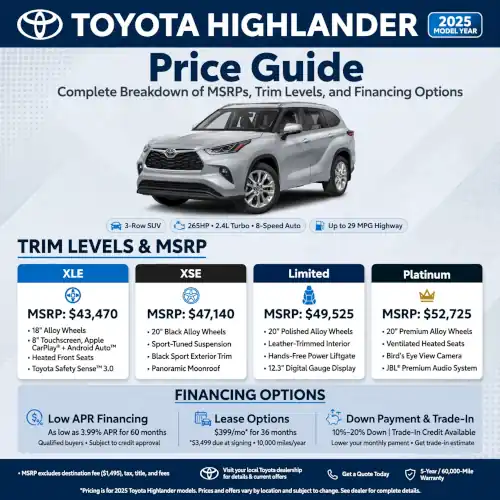
The starting MSRP for gas-powered Highlander models ranges from approximately $39,820 for remaining 2025 LE configurations up to $54,420 for fully loaded 2026 Platinum grades. Meanwhile, Highlander Hybrid variants command a modest premium of $1,500 to $1,800 over their gas counterparts, a cost difference that driver mileage often offsets within two to three years of daily commuting.
| Trim Level | Powertrain | Drivetrain | Starting MSRP (Est. Base TSRP) | EPA-Estimated Combined MPG |
| LE (2025 Gas) | 2.4L Turbo Gas | FWD / AWD Available | $39,820 | 25 MPG |
| XLE (Gas) | 2.4L Turbo Gas | Standard AWD | $46,765 | 24 MPG |
| Hybrid XLE | 2.5L Four-Cylinder Hybrid | Standard Electronic AWD | $48,515 | 35 MPG |
| XSE (Sport) | 2.4L Turbo Gas | Dynamic Torque Vectoring AWD | $48,835 | 24 MPG |
| Limited (Gas) | 2.4L Turbo Gas | Dynamic Torque Vectoring AWD | $51,220 | 24 MPG |
| Hybrid Limited | 2.5L Four-Cylinder Hybrid | Standard Electronic AWD | $52,970 | 35 MPG |
| Platinum (Gas) | 2.4L Turbo Gas | Dynamic Torque Vectoring AWD | $54,420 | 24 MPG |
| Hybrid Platinum | 2.5L Four-Cylinder Hybrid | Standard Electronic AWD | $56,170 | 35 MPG |
Note: Pricing excludes manufacturer destination, processing, and handling fees, which generally add $1,395 to $1,450 to the final sticker price depending on the model year.
Gas Engine vs. Hybrid Powertrain: Calculating the Long-Term Cost Advantage
Choosing between the turbocharged gas engine and the gas-electric hybrid setup impacts both your initial purchase price and long-term operating budget. Toyota equips gas models with a punchy 2.4-liter turbocharged four-cylinder engine generating 265 horsepower and 310 lb-ft of torque, mated to an 8-speed automatic transmission. This setup provides strong passing power and a higher maximum towing capacity of up to 5,000 pounds when properly equipped.
Turbocharged 2.4L Four-Cylinder Costs and Performance
-
Upfront Savings: Gas models carry a lower initial purchase price, saving buyers roughly $1,750 upfront compared to an equivalent hybrid trim.
-
Higher Towing Threshold: The 5,000-lb towing limit makes the gas model ideal for pulling small boats, campers, or utility trailers.
-
Fuel Expenditure: With a combined rating of 24 MPG, fuel costs run noticeably higher during heavy urban driving.
2.5L Hybrid Efficiency and Fuel Savings ROI
-
Fuel Economy Leader: The Highlander Hybrid pairs a 2.5-litre engine with electric motors to yield up to 35 MPG combined in daily driving.
-
Break-Even Analysis: Driving 15,000 miles per year saves approximately $600 to $800 annually in fuel expenses, allowing the hybrid price premium to pay for itself in under three years.
-
Towing Capability: Hybrid models feature Electronic On-Demand AWD and a 3,500-lb towing capacity, which easily handles bike racks, jet skis, or light pop-up trailers.
Toyota Highlander vs. Grand Highlander: Price and Space Trade-Offs
When researching the Toyota Highlander price range, many shoppers compare the standard Highlander against its larger sibling, the Toyota Grand Highlander. The standard Highlander measures shorter overall, making it easier to maneuver into tight suburban garages and crowded city parking spaces. However, its third row is primarily sized for children or occasional adult use.
The Grand Highlander carries a starting price premium of roughly $2,500 to $4,000 over equivalent standard Highlander trims. In exchange, the Grand Highlander delivers an expanded third row capable of comfortably seating full-sized adults, alongside significantly larger cargo capacity behind the rear seats. If your family regularly transports teenagers or needs maximum luggage space for long road trips, paying the extra upfront price for the Grand Highlander offers significant practical utility.
Total Cost of Ownership: Depreciation, Maintenance, and Resale Value
The overall purchase price represents only one part of the financial equation. Evaluating depreciation, scheduled maintenance, and insurance rates helps you establish a complete picture of ownership costs over a five-year holding period.
+-----------------------------------------------------------------+
|              5-YEAR TOTAL COST OF OWNERSHIP METRICS             |
+-----------------------------------------------------------------+
| 1. Purchase Price & Taxes   --> Initial Capital Outlay          |
| 2. Depreciation Rate        --> Retains ~55-60% Value at Yr 5    |
| 3. Maintenance & Repairs    --> $458/yr Avg (Below Class Avg)   |
| 4. Fuel & Insurance Costs   --> Optimized via Hybrid Powertrain |
+-----------------------------------------------------------------+
Five-Year Maintenance and Repair Projections
Toyota vehicles are renowned for low factory repair frequencies and affordable replacement parts. Industry automotive data indicates the Toyota Highlander averages approximately $458 per year in routine maintenance and unexpected repairs, which sits well below the $485 annual average for midsize 3-row SUVs. Major mechanical failures remain rare, making long-term extended warranties optional rather than mandatory for peace of mind.
ToyotaCare and Resale Value Protection
Every new Toyota Highlander includes ToyotaCare, a no-cost factory maintenance plan covering factory-scheduled servicing for 2 years or 25,000 miles, whichever comes first. Additionally, the Highlander consistently wins awards for high residual value retention. After five years of ownership, a well-maintained Highlander typically retains 55% to 60% of its original sticker price, significantly reducing total depreciation losses compared to rival European or domestic American SUVs.
Smart Financing Strategies: How to Secure the Best Toyota Highlander Price
Securing a competitive deal on a new or used Toyota Highlander requires leveraging timing, promotional APR rates, and direct dealer negotiations. Follow these actionable steps to lower your monthly payment:
-
Check Manufacturer Incentive Programs: Toyota routinely offers low promotional APR financing rates (such as 2.9% to 4.9% APR for qualified buyers) during end-of-quarter or holiday sales events.
-
Obtain Pre-Approved Auto Financing: Secure an independent loan approval from a local credit union or bank before visiting the showroom. This gives you leverage when comparing dealer finance office terms.
-
Evaluate Used and Certified Pre-Owned (CPO) Inventory: Late-model CPO Highlanders (2021–2024 model years) generally range between $28,000 and $38,000 depending on mileage and trim, allowing you to skip initial steep depreciation.
-
Negotiate Based on Invoice Price: Request itemised dealer pricing sheets that outline base MSRP, factory options, and dealer fees. Avoid paying over-sticker dealer markups or mandatory accessory protection packages.
-
Optimise Trade-In Value: Obtain independent trade-in valuations from online car buying platforms before handing your keys to the dealership trade appraiser.
Frequently Asked Questions (FAQs)
What is the starting Toyota Highlander price for the base model?
The starting Toyota Highlander price begins at $39,820 for remaining 2025 LE gas models. For newer 2026 models where standard All-Wheel Drive and upgraded features come built-in, the entry-level XLE trim starts around $46,765.
Is the Toyota Highlander Hybrid worth the price premium over the gas model?
Yes, for most drivers, the Toyota Highlander Hybrid is well worth the extra $1,500 to $1,800 upfront. With an EPA-estimated 35 MPG combined versus 24 MPG for the gas model, active daily commuters typically recover the price difference through gas savings in less than three years.
How does the Toyota Highlander price compare to competitors like the Kia Telluride?
The Toyota Highlander starting price sits slightly higher than competitors like the Kia Telluride or Hyundai Palisade. However, the Highlander offsets its higher initial MSRP by offering superior standard hybrid fuel efficiency, lower long-term maintenance costs, and historically stronger resale value.
What is the average price of a used Toyota Highlander?
A three-to-five-year-old used Toyota Highlander typically costs between $25,000 and $35,000 depending on condition, trim, and overall mileage. Certified Pre-Owned (CPO) models carry a slight price premium but include extended factory warranty coverage and multi-point vehicle inspections.
Finding the ideal Toyota Highlander price comes down to aligning your household budget with the trim features, seating capacity, and powertrain options that match your daily driving lifestyle. By weighing upfront MSRP against long-term fuel economy, resale value retention, and available financing incentives, you can confidently secure an exceptional three-row family SUV. For deeper historical research and model generation specifications, consult the official Toyota Highlander Wikipedia page, or explore recent market trends and automotive news on our latest search updates portal.