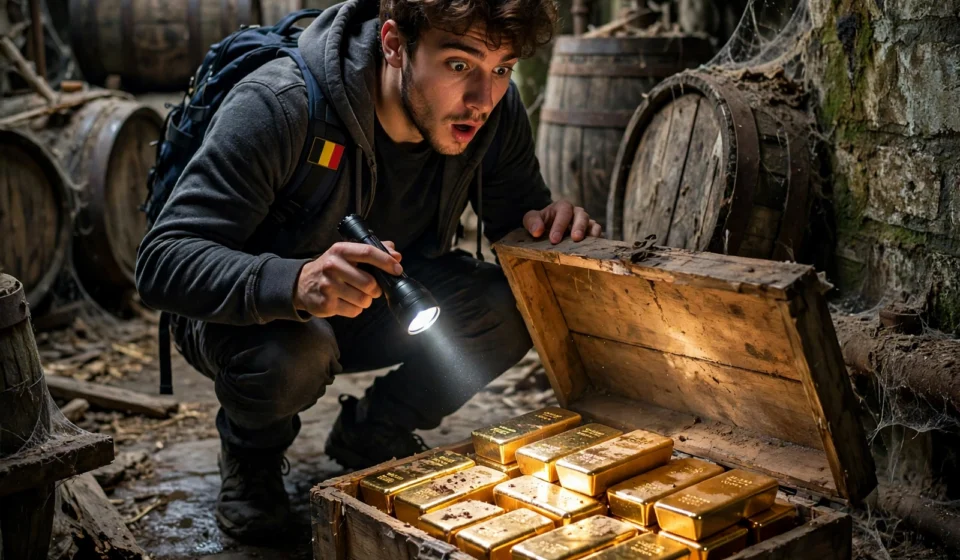

An 18-year-old Belgian student working a summer construction job made an extraordinary discovery after unearthing a hidden gold treasure trove valued at an estimated €9 million ($9.8 million). The remarkable find occurred during trench excavation for a new sewage and drainage system at the historic Brouwershuis brewery site in Sint-Gillis-Dendermonde.
What began as a routine renovation task quickly turned into one of Belgium’s most significant modern precious metal discoveries. The haul contains vintage gold coins, raw nuggets, and numbered bullion bars bricked behind a subterranean cellar wall beneath a late 19th-century villa.
The discovery has triggered an official investigation into the gold’s provenance, complex property rights laws, and the historic fortune of the prominent Van Assche brewing family.
How a Routine Sewer Job Turned Into a €9M Treasure Hunt
The discovery took place on Van Langenhovestraat in Sint-Gillis-Dendermonde, a municipality situated roughly 19 miles (30 kilometers) northwest of Brussels. The student worker, identified publicly only as Kobe, was operating alongside colleagues from local construction firm De Brand.
While digging drainage trenches for a social housing conversion, the crew encountered loose metallic pieces buried in a sealed brick partition. Kobe initially believed he had found modern loose change.
“We suddenly saw something lying there,” Kobe recounted to Belgian broadcaster VTM. “At first, I thought it was €1 coins, so we started digging them up. Then we saw a gold bar. It turned out to be a bit more than we thought”.
Discovery Breakdown:
• Estimated Total Valuation: €9,000,000 (~£8,000,000 / $9,800,000)
• Stash Contents: Rare gold coins, solid nuggets, and stamped bullion ingots
• Discovery Location: Subterranean cellar wall, Brouwershuis Villa
• Site History: Van Assche family brewery (operational 1899–1970)
The construction crew immediately halted excavation and notified both the project client, social welfare organization CAW Oost-Vlaanderen, and local law enforcement.
Historical Origins: The Van Assche Brewery and the Sealed Cellar
The property where the gold was found holds deep historical significance in East Flanders. Originally constructed in the late 19th century, the grand villa served as the private residence of wealthy industrialist Theophilus Van Assche.
Industrial brewing operations began on the site in 1899 and operated continuously until 1970. The wrought-iron entrance gates of the listed heritage property still bear the family’s prominent “VA” monogram.
According to local historians and former Dendermonde mayor Piet Buyse, the Van Assche family held immense wealth throughout the 20th century. Buyse noted that it was common practice for wealthy European dynasties during eras of geopolitical instability or wartime turmoil to convert liquid assets into physical bullion and conceal them within private estate architecture.
CAW Oost-Vlaanderen acquired the listed building to undergo a total interior gutting and modernization into administrative offices and community support housing. Because the renovation required replacing deep underground utilities, excavation crews breached cellar walls that had remained sealed for decades.
Legal Ownership, Finder’s Rights, and Belgian Property Law
The entire gold hoard was secured by police and transferred under armed escort to a specialized federal vault facility in Brussels. East Flanders public prosecutor Hanne Ollevier confirmed that authorities have launched a formal judicial inquiry to verify the assets.
Under Belgian civil law, determining legal title to concealed historical property involves rigorous legal frameworks:
-
Criminal and Illicit Asset Clearance: Prosecutors must first verify that the numbered bars and coins are not linked to historic robberies, wartime looting, or unrecorded criminal activity.
-
Statutory Five-Year Waiting Period: Belgian property legislation mandates a minimum five-year claim window during which potential heirs or claimants can present verifiable provenance records.
-
Three-Way Ownership Claims: If no criminal link is found and direct heirs fail to produce documented proof of inheritance, ownership disputes typically involve the property owner (CAW Oost-Vlaanderen), the construction contractor (De Brand), and the discovery team.
-
Statutory Finder’s Fee: Under European civil codes, discovery crews who promptly report treasure hoards to authorities are often eligible for a structured statutory finder’s fee or percentage payout.
Geert Hillaert, director of CAW Oost-Vlaanderen, indicated that should the welfare charity receive legal rights to any portion of the windfall, the funds will directly support homeless outreach programs across East Flanders.
Key Facts and Discovery Overview
| Key Detail | Investigative Record |
| Finder | Kobe (18-year-old student worker) |
| Employer | De Brand Construction |
| Site Owner | CAW Oost-Vlaanderen (Social Welfare Organization) |
| Location | Sint-Gillis-Dendermonde, East Flanders, Belgium |
| Original Builder | Theophilus Van Assche (Brouwershuis Brewery, est. 1899) |
| Valuation | Estimated €9 Million |
| Current Custody | High-security federal vault in Brussels |
Frequently Asked Questions (FAQs)
What exactly was found inside the hidden cellar?
The discovery consisted of a large quantity of precious metals, including historic gold coins, solid gold nuggets, and individually stamped and numbered gold bullion bars estimated at €9 million.
Why was the gold hidden inside the brewery wall?
Historians believe the gold was hidden by the Van Assche family, who operated the Brouwershuis brewery from 1899 to 1970. Concealing wealth within structural brickwork was a common method to safeguard family fortunes against economic collapse or wartime confiscation.
Will the 18-year-old student receive a reward?
While Belgian law requires a multi-year waiting period to settle inheritance and civil property claims, finders who report discoveries to law enforcement may qualify for a legal finder’s reward depending on the outcome of the civil proceedings.
Where is the €9 million gold haul kept right now?
Local police transferred the entire collection to a secure, specialized vault in Brussels under the oversight of the East Flanders public prosecutor’s office while legal provenance inquiries continue.
This historic Belgian gold discovery highlights how unexpected treasures remain preserved beneath European architectural heritage. As prosecutors and forensic archivists trace the century-old records of the Van Assche estate, the case stands as an extraordinary example of civic honesty and historical preservation. To learn more about historical European gold and legal treasure trove frameworks, explore the Treasure Trove overview on Wikipedia. To track the latest European property and legal news updates, search our Google Search Directory, or join the active community discussion on archaeological and historical discoveries at the NT Live News Forum.