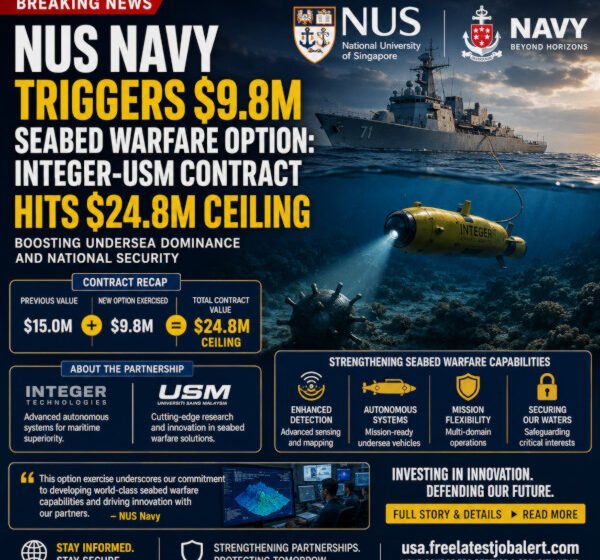
NUS Navy Triggers $9.8M Seabed Warfare Option: Integer-USM Contract Hits $24.8M Ceiling

US Business Updates: In a major move to accelerate maritime defence innovation, the U.S. Navy’s Office of Naval Research (ONR) has awarded a $9.8 million contract option modification to defence software provider Integer Technologies and the University of Southern Mississippi (USM).
The latest allocation advances the joint Intelligent Autonomous Systems for Seabed Warfare initiative, bringing the program’s cumulative funding to $24.8 million—pushing the project to 99.2% of its $25 million contract ceiling with just $200,000 in remaining capacity.
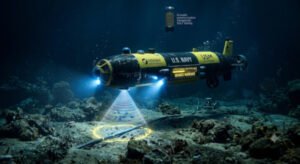
The rapid rate of funding exercise underlines the Department of Defence’s urgent priority to deploy edge artificial intelligence for uncrewed underwater vehicles (UUVs) capable of navigating contested or communications-denied maritime environments.
Key Contract Milestones and Financial Breakdown
Originally established as an applied research program with a $4.3 million base tranche, the joint initiative has expanded through options to reach its near-maximum threshold:
| Program Milestone | Allocated Tranche | Cumulative Value | Core Technical Target |
| Initial Award Base | $4.3 Million | $4.3 Million | Baseline edge AI framework & Gulfport facility setup |
| Intermediate Options | $10.7 Million | $15.0 Million | Physics-informed predictive modelling & initial ocean testing |
| Latest Contract Option | $9.8 Million | $24.8 Million | Operational decision-support tool & deep-water deployment |
| Remaining Ceiling | $0.2 Million | $25.0 Million | Final task order allocation before contract ceiling reset |
“Advancing to this next phase highlights The University of Southern Mississippi’s leadership in ocean research and blue economy innovation,” said Dr Kelly Lucas, Vice President for Research at USM. “By partnering with Integer Technologies, we are bringing high-skill jobs to the Gulf Coast and accelerating scientific advancement while expanding economic opportunity across Mississippi.”
Edge AI and Physics-Informed Oceanography
Undersea robotics operates under severe physical constraints. Because seawater rapidly absorbs radio signals, autonomous underwater vehicles cannot rely on GPS or real-time satellite telemetry.
To overcome these barriers, the Integer-USM partnership combines USM’s oceanographic engineering expertise with Integer’s predictive software algorithms:
-
Environmental Adaptation: Edge software assesses real-time water conditions, thermal layers, and ocean currents, allowing platforms to modify mission parameters autonomously.
-
Seafloor Target Recognition: Machine learning models process high-dimensional sonar datasets on board the vessel to identify submerged objects and critical seabed infrastructure.
-
Denied Environment Navigation: Software gives platforms the ability to “reason at the edge” when communication with human operators is interrupted.
“The Navy’s mission demands systems that can interpret uncertainty, reason at the edge, and provide operators of UxVs with assurance of their mission in intermittent or denied communications environments,” stated Josh Knight, COO and co-founder of Integer Technologies. “The work we’re doing with USM is about redefining how the fleet leverages data, physics, and AI to create persistent, intelligent capability in the undersea domain.”
Testing is conducted through Integer’s dedicated facility at USM’s Roger F. Wicker Centre for Ocean Enterprise in Gulfport, Mississippi, providing direct ocean access for rapid prototyping.
Investor Insights & Defence Tech Market Exposure
Because Integer Technologies is a privately held defence contractor, direct public equity investment in the firm is unavailable. However, market analysts track awards in autonomous maritime systems to gauge broader growth in defence technology research and development.
Investors seeking public market exposure to the growth in autonomous undersea warfare and subsea defence technology monitor several key industry sectors:
-
Maritime Robotics & Sonar Hardware: Public prime contractors specialising in unmanned undersea vehicles, hydrographic imaging, and sensor suites (e.g., Teledyne Technologies, Kratos Defence).
-
Tier-1 Naval Defence Integrators: Large-displacement unmanned submarine builders and naval shipyards (e.g., Northrop Grumman, General Dynamics, Lockheed Martin).
-
Government Procurement Databases: Tracking formal defence budget requests, small business innovation research (SBIR) transitions, and solicitations via official portals such as the U.S. Department of Defence Contracts Directory and SAM.gov Federal Opportunities.
Next Steps for the $25M Contract Ceiling
With cumulative allocations reaching $24.8 million, the Office of Naval Research is expected to evaluate procurement options as the remaining $200,000 capacity is absorbed.
Options under Federal Acquisition Regulations include issuing a formal contract modification to raise the total ceiling, transitioning the tested algorithms into a Phase III SBIR production program, or establishing a follow-on sole-source research vehicle to sustain testing along the Mississippi Gulf Coast.
As subsea cable safety and ocean floor monitoring remain vital to national security, the Integer-USM software framework continues to establish baseline standards for autonomous naval operations.
Related Resources & Industry Reading
-
External Reference: Official program announcements and oceanographic research projects at The University of Southern Mississippi.