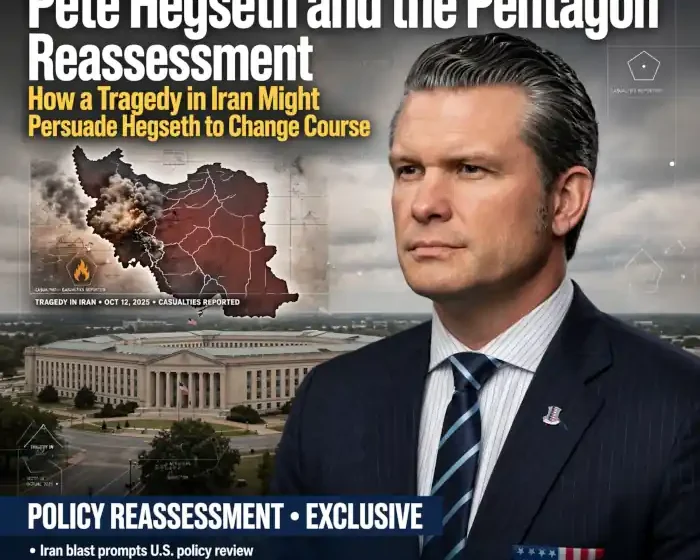
Pete Hegseth and the Pentagon Reassessment: How a Tragedy in Iran Might Persuade Hegseth to Change Course

The balance between tactical lethality and operational restraint remains one of the most critical debates within modern national defence strategy. Following recent military operations in the Middle East—specifically surrounding the fallout from an Iranian school strike—defence analysts, foreign policy experts, and national security lawmakers are closely watching how the United States ‘ defence leadership responds.
At the centre of this international discourse is Secretary of Defence Pete Hegseth. As international scrutiny intensifies over non-combatant protections during active military engagements, strategic policy advisors are re-examining the operational frameworks that govern target selection, collateral damage estimation, and rules of engagement in urban warfare environments.
The Strategic Shift in Military Policy: Lethality vs. Operational Restraint
The evolution of the United States ‘ defence policy over recent decades has reflected shifting political priorities, military doctrines, and international legal mandates. Upon taking office, Defence Secretary Pete Hegseth prioritised enhanced combat lethality and streamlined military command structures, leading to a dramatic downsizing of specialised staff dedicated strictly to civilian casualty mitigation.
Historically, these civilian protection mechanisms were built up after lessons learned from multi-decade conflicts in Iraq and Afghanistan, reinforced by congressional mandates:
-
Collateral Damage Estimation (CDE): Advanced intelligence modelling used to evaluate non-combatant impact before authorizing precision strikes.
-
Specialized Civilian Oversight Cells: Dedicated personnel embedded across combatant commands to review operational intelligence and strike protocols.
-
Post-Strike Assessment Teams: Units tasked with investigating incidents on the ground to ensure transparency and refine future target verification.
+-------------------------------------------------------------------------+
|                  U.S. DEFENSE POLICY REEVALUATION                       |
+-------------------------------------------------------------------------+
|                                                                         |
|   HISTORICAL APPROACH               CURRENT POLICY DEBATE               |
|   • Expanded Casualty Mitigation    • Prioritization of Lethality       |
|   • Specialized Oversight Teams     • Downsized Administrative Staff    |
|   • Congressional Oversight         • Direct Strike Authority Focus     |
|                                                                         |
+-------------------------------------------------------------------------+
                                     |
                                     v
+-------------------------------------------------------------------------+
|                      STRATEGIC IMPACT & REASSESSMENT                    |
|   • Re-examination of Target Verification Protocols                     |
|   • Foreign Policy & Diplomatic Relations Realignment                   |
|   • Legal Liability & International Humanitarian Law Compliance          |
+-------------------------------------------------------------------------+
While policy shifts aimed at reducing administrative friction can accelerate tactical execution, high-profile battlefield tragedies often force defence strategists to re-evaluate whether operational restraint is inherently linked to long-term military success.
Geopolitical Implications and International Humanitarian Law
In modern warfare, the intersection of military technology, real-time intelligence gathering, and precision-guided munitions plays a crucial role in preventing unintended outcomes. When military strikes result in damage to non-combatant infrastructure—such as educational facilities—the ramifications spill over into global diplomacy and defence policy.
1. Diplomatic Strain and Foreign Alliances
Unintended civilian casualties frequently complicate diplomatic relations between allied nations. International defence agreements and coalition-building rely heavily on adherence to International Humanitarian Law (IHL) and established rules of engagement.
2. Counterinsurgency and Strategic Objectives
U.S. military doctrine has long emphasised that non-combatant harm can undermine broader strategic goals. Protecting civilian populations is increasingly viewed not only as a moral imperative, but as a strategic requirement for long-term regional stability.
3. Congressional Oversight and Defence Legislation
The United States Congress exercises direct oversight of defence operations through the annual National Authorization Act (NDAA). Reports of operational deficiencies or civilian harm frequently prompt legislative inquiries, defence audits, and updated statutory mandates for military transparency.
| Strategic Policy Factor | Tactical Objective | International & Legal Consideration |
| Precision Targeting | Neutralise high-value targets efficiently | Compliance with the Law of Armed Conflict (LOAC) |
| Operational Speed | Maintain battlefield initiative | Thorough collateral damage assessment requirements |
| Defense Transparency | Build public trust and international credibility | Protection of classified intelligence sources |
Legal, Financial, and Defence Contracting Insights
Beyond immediate military policy, defence doctrines significantly shape the broader defence contracting ecosystem, commercial aerospace logistics, and government risk management sectors.
Major aerospace defence contractors, technology firms, and risk management consultants monitor Pentagon directives to align hardware and software capabilities with evolving military requirements:
-
Government Procurement Compliance: Defence vendors manufacturing precision strike hardware, sensor fusion software, and autonomous systems must adhere to strict federal defence procurement regulations.
-
Risk Management & Civil Liability: Defence enterprises utilise specialised legal counsel and risk management strategies to navigate complex international trade regulations, ITAR compliance, and defence insurance structures.
-
Defence Tech Innovation: Venture capital allocations in defence technology are increasingly focused on real-time decision support, target verification software, and non-lethal defence mechanisms.
As defence leadership assesses the balance between rapid execution and oversight, technology contractors are tasked with developing higher-precision hardware and advanced analytics to assist commanders during high-stakes engagements.
The Path Forward for Defence Leadership
The ongoing evaluation within the Pentagon demonstrates the complex nature of modern national security. As conflict environments become increasingly urbanised, defence officials face the perpetual challenge of maintaining high-level combat capability while safeguarding non-combatant populations.
Whether driven by diplomatic considerations, congressional inquiry, or battlefield realities, the capacity of military leadership to adapt policy in response to critical events remains essential to national defence strategy.