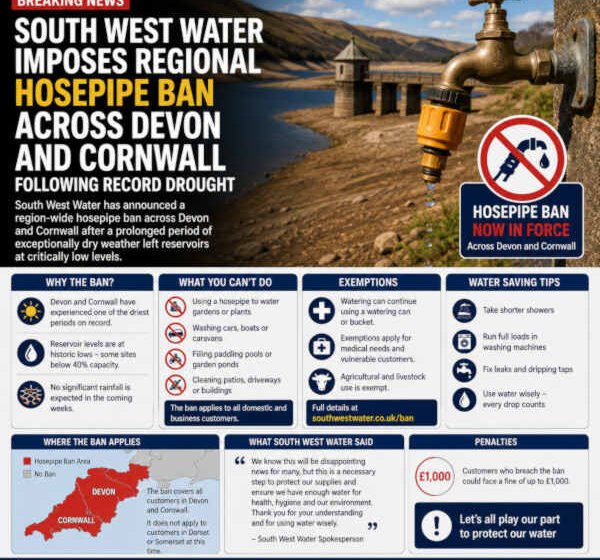
South West Water Imposes Regional Hosepipe Ban Across Devon and Cornwall Following Record Drought

EXETER, UK : A comprehensive regional hosepipe ban will cover Devon, Cornwall, parts of Dorset and Somerset, and the Isles of Scilly starting from midnight on Saturday, August 8, 2026, following months of exceptionally low rainfall and unprecedented summer demand on local water infrastructure.
The water utility provider, South West Water, officially announced the Temporary Use Ban (TUB) as regional reservoir levels continue to drop and river flows approach critical baselines after a prolonged period of dry weather across the South West peninsula.
South West Water Regional Hosepipe Restriction overview
| Operational Aspect | Official Policy Details |
| Water Utility Provider | South West Water |
| Effective Date & Time | Midnight (00:01 BST), Saturday, 8 August 2026 |
| Geographic Coverage | Whole of Devon, Cornwall, Isles of Scilly, parts of Dorset & Somerset |
| Primary Trigger | Significantly below-average rainfall, heatwaves, and sustained demand |
| Enforcement Penalty | Statutory fines of up to £1,000 under the Water Industry Act 1991 |
| Affected Population | Approximately 1.8 million residents plus seasonal summer tourists |
Detailed Breakdown of Restricted vs. Allowed Water Activities
Under the statutory terms of the Temporary Use Ban enforced by South West Water, mains water supplied via a hosepipe, pressure washer, or connected apparatus is strictly prohibited for non-essential domestic and recreational activities.
Banned Activities (Using Mains Hosepipes, Sprinklers, or Pressure Washers)
-
Garden & Lawn Maintenance: Watering lawns, flower beds, allotments, or vegetable patches using hosepipes, automatic sprinklers, or micro-drip systems without automated pressure-reducing timers.
-
Vehicle & Boat Cleaning: Washing private motor vehicles, motorcycles, caravans, or leisure boats with a hosepipe or pressure washer.
-
Home & Exterior Maintenance: Cleaning outdoor patios, driveways, exterior walls, decking, garden paths, or windows using attached hose apparatus.
-
Recreational Water Use: Filling or topping up domestic swimming pools, paddling pools, hot tubs, or ornamental garden ponds.
Permitted Uses (Essential Household Water Supplies)
-
Essential Sanitation & Food Prep: Drinking water, cooking, food preparation, toilet flushing, personal showering, and indoor domestic cleaning remain completely unrestricted.
-
Bucket & Watering Can Usage: Gardening and car washing using water carried manually in buckets or watering cans fed from taps or water butts.
-
Rainwater & Non-Mains Harvesting: Water drawn from non-mains sources, such as rainwater butts, greywater recycling systems, private boreholes, or harvested runoff.
Statement from South West Water Leadership
Representing South West Water, Water Services Director Sam Bottomley detailed the operational factors driving the decision and outlined the emergency infrastructure measures deployed by the utility.
“After an extended period of exceptionally low rainfall, combined with sustained high demand during the warmer weather, our region’s rivers and water resources are under significant pressure. This decision has considered the Environment Agency’s drought status as well as the increase in demand in our region.“Our teams have been working tirelessly to protect supplies for customers. We‘ve maximised water production wherever possible, increased leak detection and repairs, moved water around our network and introduced a wide range of operational measures to make the best use of the water available.“Introducing a hosepipe ban is never a decision we take lightly, and we fully appreciate the inconvenience it will cause. However, these temporary restrictions are an important step in helping to protect our rivers and essential water supplies for homes, businesses and critical services across the region.“Every litre saved now will help protect our rivers and water resources while drought conditions continue. By making small changes to how we use water, our customers can make a real difference.”Sam Bottomley, Water Services Director at South West Water
Environmental Context: Driest July on Record and Regional Drought
The announcement follows warnings from climate scientists and environmental monitoring groups, which confirmed that July 2026 was one of the driest recorded in the South West in over a century. The Environment Agency officially declared drought status across half of England earlier this summer, with Devon and Cornwall experiencing severe hydrological pressure.
Sub-surface aquifers and key storage reservoirs across the region have seen water reserves drop rapidly under the combined strain of elevated summer temperatures and the annual surge in tourism. With hundreds of thousands of holidaymakers visiting coastal resorts across Cornwall, Devon, and the Isles of Scilly, daily water consumption in peak weeks surged significantly above historical seasonal averages.
South West Water Hydrological Cycle & Demand Pressure:
[Extended High Temperatures & Low Rainfall]
   └──> [Depleted Reservoirs & Decreased River Flows]
           └──> [Peak Summer Tourism & Increased Consumption]
                   └──> [Enforcement of Regional Hosepipe Restrictions]
Statutory Exemptions and Priority Services Register
South West Water confirmed that specific statutory exemptions apply to safeguard vulnerable residents and support commercial operations vital to the regional economy.
Key Exemptions Granted:
-
Priority Services Register & Blue Badge Holders: Customers registered on South West Water’s Priority Services Register or holding a valid Blue Badge due to mobility or health conditions may use hosepipes to water gardens or wash vehicles where manual carrying of water is unfeasible.
-
Commercial & Business Operations: Commercial car washes, professional window cleaners using water-fed poles, agricultural livestock welfare operations, and commercial plant nurseries are exempt where hosepipe usage is integral to business operations.
-
Animal Welfare & Health Safety: Filling troughs for agricultural livestock or cleaning animal enclosures to maintain essential health and hygiene standards.
Community Guidelines: Practical Actions to Conserve Regional Water
To assist South West Water in preserving reservoir levels through late summer and autumn, residents, agricultural producers, and tourists are being urged to adopt daily water conservation practices.
Everyday Household Water-Saving Tips:
-
Shorter Showers: Reducing shower time to four minutes can save up to 12 litres of water per person per day.
-
Tap Management: Turning off running taps while brushing teeth or shaving saves up to 6 litres per minute.
-
Full Machine Loads: Running dishwashers and washing machines only when fully loaded to maximise energy and water efficiency.
-
Garden Water Harvesting: Reusing bathwater or dishwashing greywater for potted plants and installing water butts to capture future rainfall.
Conclusion
As the ban takes effect from midnight on August 8, South West Water’s engineering teams continue round-the-clock monitoring of water treatment works, pumping stations, and distribution networks. The utility has deployed additional leakage detection units utilising acoustic sensors and satellite imagery to reduce distribution losses across its thousands of miles of underground pipework.
Environmental agencies stress that lifting the temporary restrictions will require sustained autumn rainfall to replenish subterranean aquifers and restore reservoir capacities to safe operational thresholds. Residents across Devon, Cornwall, and adjacent counties are advised to regularly check South West Water’s official postcode tool for localised updates as drought monitoring continues throughout the season.