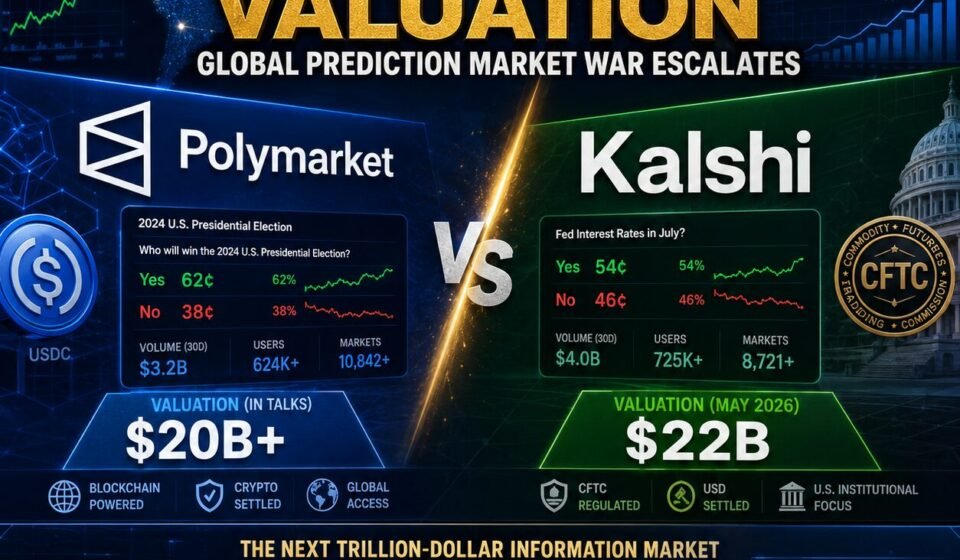
Polymarket Targets $20 Billion Valuation as Global Prediction Market War Escalates

NEW YORK: Decentralised prediction market platform Polymarket is in early-stage talks with investors to raise roughly $1 billion in fresh capital at a valuation exceeding $20 billion, according to sources familiar with the transaction. The ambitious funding push comes just months after the company closed a $1 billion funding round at a $15 billion valuation in April, reflecting an unprecedented surge in institutional demand for real-time event-based derivative trading.
The massive valuation target signals a dramatic escalation in the battle for dominance within the rapidly expanding prediction market ecosystem. Driven by record-breaking trading volumes across major sporting events, geopolitical conflicts, and macroeconomic data releases, event forecasting has transitioned from a niche crypto experiment into a mainstream pillar of modern digital finance.
Inside the Numbers: Polymarket’s Skyrocketing Trajectory
The new $1 billion round under discussion highlights how rapidly capital is flowing into blockchain-settled information platforms. If completed at the targeted $20 billion metric, Polymarket’s enterprise value will have more than doubled from its October 2025 mark of $9 billion.
Polymarket Valuation Growth (2025 – 2026 Target)
================================================
Oct 2025 : $9.0 Billion
Apr 2026 : $15.0 Billion
Aug 2026 : $20.0+ Billion (Targeted)
Key Funding Highlights
-
Anchor Institutional Backing: Polymarket’s $15 billion April round was anchored by a $600 million strategic investment from Intercontinental Exchange Inc. (ICE), the parent company of the New York Stock Exchange.
-
Consortium of Heavyweights: Additional institutional backing in recent months has featured prominent Wall Street and Silicon Valley firms, including D.E. Shaw & Co., G Squared, SV Angel, Dragonfly, and Valor Equity Partners.
-
Revenue Expansion: Despite cyclical dips in volume during early spring, platform trading rebounded sharply during global sporting milestones such as the FIFA World Cup. Annualised revenues surpassed $1 billion earlier this summer.
The Duel for Market Dominance: Polymarket vs. Kalshi
The prediction market sector has effectively consolidated into a high-stakes duopoly between Polymarket and its primary U.S. rival, Kalshi. While both platforms offer users the ability to trade binary “Yes/No” contracts on real-world events, their underlying architectures, regulatory philosophies, and target demographics represent fundamentally different approaches.
+------------------------+------------------------------------+------------------------------------+
| Feature                | Polymarket                         | Kalshi                             |
+------------------------+------------------------------------+------------------------------------+
| Architecture           | Blockchain / Polygon Infrastructure| Centralized Match Engine           |
| Settlement Asset       | USDC / Crypto                      | U.S. Dollars (USD)                 |
| Regulatory Status      | Off-shore / Crypto-Native          | Federally Regulated (CFTC)         |
| Recent Valuation       | $20B+ (In Talks)                   | $22B (Series F, May 2026)          |
| Annualized Revenue     | > $1.0 Billion                     | > $1.5 Billion                     |
| Primary Investor Base  | Web3 VCs, ICE, Hedge Funds         | Coatue, a16z, Sequoia, Morgan St.  |
+------------------------+------------------------------------+------------------------------------+
The Institutional Push Behind Kalshi
Kalshi’s growth trajectory has kept pace with Polymarket’s. In May 2026, Kalshi closed a landmark $1 billion Series F round led by Coatue Management, with participation from Andreessen Horowitz (a16z), Sequoia Capital, Ark Invest, and Morgan Stanley. The round elevated Kalshi’s valuation to $22 billion, backed by annualised revenues reaching $1.5 billion.
Kalshi’s position as a federally regulated exchange overseen by the Commodity Futures Trading Commission (CFTC) has given it a clear advantage among U.S. institutional accounts and conservative financial entities. However, this regulatory perimeter has also brought legal friction: Kalshi currently faces litigation across 19 U.S. state jurisdictions over the boundary between financial event contracts and state-level gambling statutes.
Beyond Betting: The “Almanack for the Future” Vision
Polymarket founder and CEO Shayne Coplan has consistently pushed back against labelling the platform as a gambling or betting site. Instead, Coplan frames the platform as a real-time, incentive-aligned information engine.
“Prediction markets let people put their money where their mouth is when they disagree with consensus,” Coplan noted in a recent public appearance. “It acts as a very useful thermometer of the world, helping humanity assess the true probability of future outcomes.”
Key Operational Driver: Incentivised Accuracy: Unlike traditional polling or opinion surveys, market participants face direct financial consequences for incorrect forecasts. This dynamic creates pricing that often anticipates breaking news faster than traditional media outlets.
-
Expansion to Micro-Markets: Polymarket is expanding beyond major geopolitical elections and macro financial metrics into granular global topics—including climate indicators, corporate earnings metrics, technology release dates, and supply chain timelines.
-
Information Arbitrage: Financial analysts and risk managers increasingly utilise prediction market odds as hedging inputs for broader equity and commodity portfolios.
Retail Super-Apps Jump In: Coinbase and Robinhood
The multi-billion-dollar valuations granted to Polymarket and Kalshi reflect a fundamental shift in retail trading dynamics. Major consumer brokerages and fintech platforms are racing to integrate prediction market infrastructure directly into their apps to capture retail trading activity.
-
Robinhood (HOOD): Expanded its event-contract suite, permitting retail users to trade macroeconomic predictions directly alongside equities and options.
-
Coinbase (COIN): Embedded decentralised prediction contract routing into its self-custody wallet and trading platform, broadening access to blockchain-settled order books.
-
Crypto Super-Apps: Dozens of crypto-native consumer applications have begun white-labeling Polymarket’s liquidity pools via API, enabling seamless betting on live outcomes directly inside social and financial apps.
Regulatory Frontiers and Future Outlook
As total monthly volume across prediction platforms regularly clears $25 billion globally, regulatory scrutiny remains the primary risk factor facing the sector.
While Kalshi navigates state-level legal challenges in courts across Massachusetts, New Jersey, Nevada, and Illinois, decentralised platforms like Polymarket operate in a complex cross-border regulatory environment. Polymarket’s strategic alliance with Intercontinental Exchange (ICE) suggests the company may be preparing for a dual-structured approach: maintaining its high-efficiency crypto order book internationally while developing fully compliant onshore financial instruments for U.S. institutional desks.
If Polymarket successfully closes its $1 billion round at a valuation above $20 billion, it will cement its status as one of the most valuable private fintech platforms in the world—proving that forecasting the future has become one of digital finance’s most lucrative businesses.