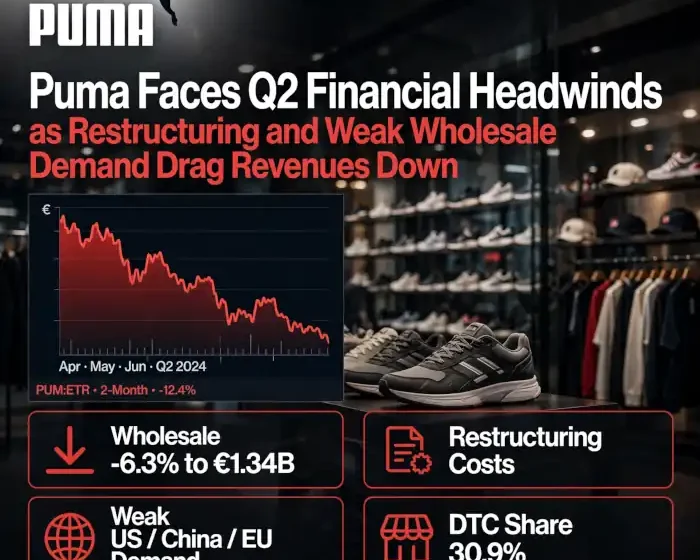
Puma Faces Q2 Financial Headwinds as Restructuring and Weak Wholesale Demand Drag Revenues Down

HERZOGENAURACH, Germany: Another top USA FINANCIAL breaking news updates on PUMA in 2026. German athletic apparel titan Puma reported a sharp drop in its second-quarter top line as corporate restructuring efforts and softening consumer demand weighed heavily on performance. Revenue for the quarter fell nearly 10% year-over-year, dropping to just under €1.7 billion.
The company cited steep declines in its wholesale business across North America and Europe as the primary catalyst for the revenue drop. To protect brand equity and clear out excess stock, management intentionally curbed sell-in shipments to mass-merchant retail channels. However, ongoing geopolitical tensions, particularly consumer pushback and market disruptions linked to the Middle East conflict, further exacerbated weak purchasing patterns in key international markets.
Despite intense cost-cutting initiatives and organisational changes, Puma remains firmly in the red. The company’s adjusted loss before interest and taxes (EBIT) widened to €41.9 million from €24.5 million in the same period last year. On a positive note, Puma narrowed its overall net loss by more than 70% to €72.8 million, benefiting from a significant drop in one-off severance and restructuring expenses compared to prior quarters.
Strategic Reset Triggers Short-Term Wholesale Pain
Puma’s current executive leadership views 2026 as an essential transition period designed to pivot the company toward higher-margin sales channels. Rather than flooding discount stores with off-price footwear and apparel, the sportswear maker has deliberately slashed volume shipped to low-margin partners.
This strategic pullback heavily impacted Western markets:
-
North America: Wholesale revenue suffered severe double-digit contractions as major retail buyers tightened order volumes.
-
Europe, Middle East, and Africa (EMEA): Sales dropped over 12%, hammered by sluggish European retail foot traffic and persistent Middle East instability.
-
Latin America: Weak macro-economic conditions drove a 13.8% dip in regional revenue.
By cutting back on wholesale inventory sell-in, Puma is attempting to execute a comprehensive wholesale distribution channel optimization strategy. While reducing shipments to mass merchants hurts near-term revenue, executives argue it is necessary to eliminate heavy promotional discounting and rebuild full-price sell-through rates across core athletic lines.
APAC Growth and Footwear Performance Highlights
Not every geographic region delivered gloomy news. In the Asia-Pacific (APAC) territory, Puma scored an 8.6% revenue increase. Strong regional appetite for low-profile lifestyle footwear—such as the revived Speedcat sneaker collection—and rising engagement in specialized running categories helped buffer broader global headwinds.
Nonetheless, footwear remains Puma’s largest product division, and broader industry trends dragged total shoe revenues down nearly 12% to €935.6 million. Apparel sales fell 4.3% to €552.1 million, while accessories faced a 12% drop. High-performing niche categories like HYROX fitness gear and technical running gear gained traction, but they lacked the volume required to fully offset weakness across mass-market lifestyle categories.
Cost Efficiencies and Inventory Clean-Up Pay Off
While top-line growth halted, Puma achieved notable operational wins behind the scenes. Management executed aggressive retail inventory management and working capital controls, generating over €320 million in free cash flow during the quarter.
| Financial Metric | Q2 Current Year | Q2 Prior Year | Year-over-Year Shift |
| Total Revenue | ~€1.69 Billion | ~€1.87 Billion | -9.4% (organic) |
| Adjusted EBIT Loss | -€41.9 Million | -€24.5 Million | Widened |
| Net Loss | -€72.8 Million | -€247.5 Million | Narrowed by >70% |
| Gross Margin | 48.0% | ~46.8% | +120 bps Expansion |
A key highlight was the expansion of Puma’s gross profit margin to 48.0%. Lower ocean freight rates, favourable channel mix adjustments, reduced raw material sourcing costs, and key tariff refunds from U.S. customs authorities provided a much-needed financial boost.
By streamlining administrative overhead and eliminating redundant corporate positions, Puma significantly reduced its fixed cost structure. These efficiency gains explain why the company successfully narrowed its net bottom-line losses even as top-line revenue shrank.
Navigating Industry-Wide Challenges into 2027
Puma’s current struggles mirror broader friction across the global sportswear industry. Competitors like Nike and Adidas have also encountered cautious consumer spending, elevated interest rates, and volatile global logistics routes. However, Puma’s aggressive move to overhaul its retail footprint makes its short-term metrics appear particularly volatile.
Wall Street and European equity markets reacted cautiously to the earnings report. Shares of Puma SE dropped over 5% in early trading following the announcement. Investors expressed frustration that, despite beating low-end earnings expectations, management refrained from raising full-year financial guidance.
Puma reaffirmed its existing full-year target, anticipating a low-to-mid single-digit drop in currency-adjusted sales and a full-year operating loss (EBIT) between €50 million and €150 million. Chief Executive Officer Arthur Hoeld assured analysts that the second half of the year will show sequential improvement as inventory levels normalise and direct-to-consumer e-commerce channels expand.
The Road Ahead for the German Sportswear Giant
Puma’s management has labelled 2026 a non-negotiable “reset year.” By prioritising corporate restructuring, brand heat, and distribution cleanup over raw volume, the brand aims to establish a structurally healthier, more profitable business model.
If Puma can successfully execute its digital expansion, maintain cost discipline, and revitalise demand for its core performance footwear, leadership expects a return to sustainable top-line growth starting in 2027. Until then, investors must navigate a tough retail environment as the iconic cat brand rebuilds its foundation from the ground up.