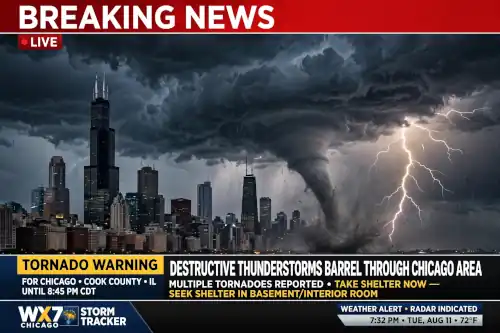
Tornado Warning Chicago: Destructive Thunderstorms Barrel Through Chicago Area with Multiple Tornadoes Reported

CHICAGO :A massive line of destructive, fast-moving severe thunderstorms barreled through the greater Chicago metropolitan area and Northwest Indiana on Tuesday morning, unleashing hurricane-force wind gusts, torrents of rain, and multiple radar-confirmed tornadoes.
The severe weather system knocked out power to over 500,000 homes and businesses across northern Illinois and Indiana, triggered citywide tornado sirens in Chicago and surrounding suburbs, grounded flights at major airports, and snapped trees and utility poles like toothpicks. The National Weather Service (NWS) Chicago office issued multiple urgent Tornado Warnings and Severe Thunderstorm Warnings throughout the morning, urging millions of residents to seek subterranean or interior shelter immediately.
Timeline of the Tempest: From Western Suburbs to Indiana
The storm system intensified rapidly during the mid-morning hours, driven by intense summer humidity and strong atmospheric instability.
-
10:15 AM CDT: Tornado sirens began blaring across Kendall and Kane counties, including the communities of Aurora and Plainfield. Aurora University immediately instructed students and staff to take cover in interior shelters.
-
10:24 AM CDT: Doppler radar recorded straight-line wind gusts peaking at an astonishing 98 mph to 120 mph near Plainfield and the southern Chicago suburbs, tearing roofs from commercial buildings and uprooting decades-old trees.
-
10:45 AM CDT: Outdoor warning sirens sounded across Chicago neighborhoods. The NWS confirmed a rain-wrapped, Doppler radar-detected tornado located near Homewood-Flossmoor, moving east at a breakneck speed of 70 mph. Meteorologists indicated the rotation was consistent with an EF-2 tornado.
-
11:00 AM CDT: The line crossed the state line into Northwest Indiana, where another radar-confirmed tornado touched down near Crown Point, leaving widespread destruction in its wake.
STORM TIMELINE & METRICS (CHICAGO METRO AREA)
--------------------------------------------------------------------------
Time (CDT)   Location                Peak Gust / Event        Status
--------------------------------------------------------------------------
10:15 AM     Aurora / Plainfield     Sirens Activated         Shelter Urged
10:24 AM     South Suburbs           98 – 120 mph Gusts       Roof / Tree Damage
10:45 AM     Homewood-Flossmoor      Radar Tornado (EF-2 est.) Moving East @ 70mph
11:00 AM     Crown Point, IN         Radar-Confirmed Tornado  Widespread Outages
--------------------------------------------------------------------------
Both O’Hare International Airport and Midway International Airport issued temporary ground stops as squalls swept over airfield runways. Utilities reported catastrophic grid damage, with ComEd reporting over 289,000 outages in northern Illinois and NIPSCO reporting more than 273,000 outages across Northwest Indiana.
Widespread Destruction & Infrastructure Impacts
In addition to tornadic rotation, the storm produced destructive straight-line winds—often referred to as a derecho-style squall line. The shear volume of falling trees damaged homes, crushed parked vehicles, and blocked roadways throughout Cook, DuPage, Will, and Lake counties.
Emergency crews and utility line workers scrambled to respond, though ongoing rainfall and flash flood advisories hindered initial cleanup efforts. Local forestry departments prioritized clearing major arterial streets to allow emergency vehicles to reach damaged residential areas.
Navigating Insurance Coverage for Severe Weather Calamities in the USA
When severe weather events—such as tornadoes, straight-line winds, hail, and flash floods—cause extensive property destruction, navigating insurance claims becomes a critical priority for affected homeowners and business owners. Understanding how policies respond to natural disasters helps ensure complete recovery.
1. Homeowners Insurance (HO-3 & HO-5 Policies)
Standard homeowners insurance policies in the United States generally cover physical damage caused by windstorms, tornadoes, hail, and falling trees.
-
Wind & Tornado Damage: Direct structural damage to roofs, siding, windows, and attached garages caused by tornadic winds or straight-line gusts is covered under the primary policy (Coverage A – Dwelling).
-
Personal Property: Items damaged inside the home due to wind-driven rain or structural compromise fall under Coverage C – Personal Property.
-
Tree Removal Limits: If a neighbor’s tree falls onto your house or driveway due to a storm, your insurance typically pays for removal and repairs (minus your deductible). However, if a tree falls in an open yard without striking a structure, tree removal coverage may be capped at $500 to $1,000 or excluded entirely.
-
Loss of Use / Additional Living Expenses (ALE): If your home is rendered uninhabitable due to storm damage or prolonged power loss caused by physical structural harm, Coverage D (Loss of Use) reimburses temporary hotel stays, meals, and relocation costs.
2. The Flood Exclusions Warning
It is crucial for homeowners to recognize that standard homeowners insurance policies strictly exclude flood damage. Water damage caused by rising groundwater, overflowing rivers, or heavy surface runoff during severe storms requires a separate policy through the National Flood Insurance Program (NFIP) or a private flood insurance carrier.
Key Rule: Water that enters through a storm-damaged roof or broken window is considered windstorm damage (covered). Water that pools on the ground and seeps into a basement or foundation is considered flooding (excluded under standard policies).
3. Auto Insurance Coverage (Comprehensive)
Vehicle damage from tornadoes, crushed roofs from falling tree limbs, hail dents, or rising floodwaters is covered exclusively under Comprehensive Auto Coverage. Basic state-minimum liability insurance does not cover natural disasters.
4. Commercial & Business Interruption Insurance
Business owners impacted by power outages, structural damage, or mandatory civil closures during severe storms rely on commercial property policies:
-
Commercial Property: Covers building structures, equipment, inventory, and signage damaged by wind or tornado debris.
-
Business Interruption (BI): Reimburses lost operating income and ongoing payroll if a physical disaster forces a temporary shutdown.
Key Steps to Take When Filing a Storm Damage Claim
                             CLAIM PROCESS FLOWCHART

  [ 1. Ensure Safety ] ---> [ 2. Document Damage ] ---> [ 3. Emergency Repairs ]
  (Check for hazards)       (Photos & videos)           (Tarp roofs / board up)
                                                                 |
  [ 6. Settlement ]   <--- [ 5. Claims Adjuster ]  <--- [ 4. File Claim ]
  (Review payout)           (Site inspection)           (Contact insurer)
-
Document Everything Immediately: Take extensive photos and videos of all interior and exterior damage before starting any cleanup or throwing away destroyed items.
-
Mitigate Further Damage: Make temporary emergency repairs—such as placing tarps over exposed roofs or boarding up broken windows—to prevent rain from causing additional water damage. Save all receipts for materials.
-
Keep Detailed Records: Maintain a dedicated log of all communications with your insurance company, adjuster visits, and contractor estimates.
-
Avoid Fraudulent Contractors: Following major severe weather events, “storm-chasing” contractors often solicit door-to-door. Always verify state licensing, insurance, and local references before signing repair contracts.
Frequently Asked Questions (FAQs)
What is the difference between a Tornado Watch and a Tornado Warning?
A Tornado Watch means atmospheric conditions are favorable for the development of tornadoes over a broad area; residents should stay alert. A Tornado Warning means a tornado has been sighted by storm spotters or indicated by Doppler radar; individuals in the warned area must seek shelter immediately.
Are tornadoes covered under standard homeowners insurance in Illinois?
Yes. Tornadoes and windstorms are covered perils under standard HO-3 homeowners insurance policies nationwide, including Illinois.
Does homeowners insurance cover food spoilage during a storm-induced power outage?
Many policies include coverage for food spoilage caused by off-premises power outages, typically up to $500 with a low or waived deductible. Check your policy endorsement details.
What should I do if my car is damaged by a falling tree limb during a tornado?
File a claim under the Comprehensive section of your auto insurance policy. Take photos of the vehicle with the branch or tree before attempting to move it.
How quickly must I file an insurance claim after a storm?
Insurers recommend reporting claims as soon as reasonably possible. Most policies require prompt notice, and waiting months can complicate proving that damage was caused directly by the severe weather event.