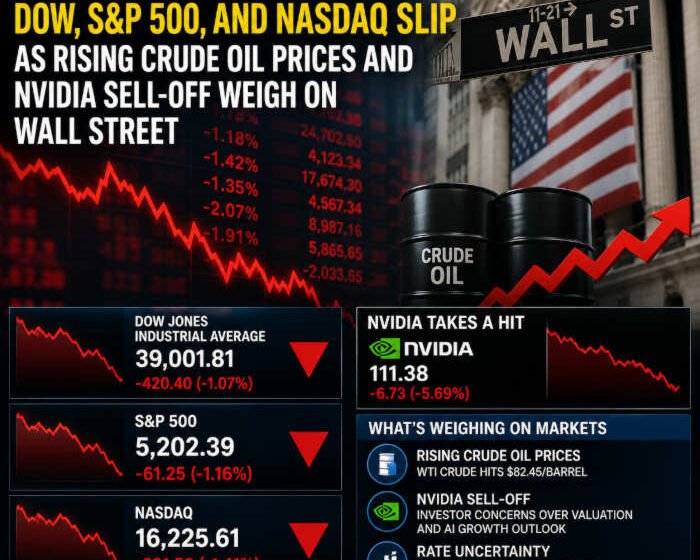

Stock Market News USA: Wall Street experienced a cautious turn on Monday, with major U.S. stock indices slipping into negative territory as a sharp spike in global crude oil prices and a notable pullback in semiconductor giant Nvidia Corp. (NVDA) dampened market sentiment. Coming off a record-setting stretch, investors spent the session recalibrating expectations ahead of critical inflation data, key Treasury auctions, and upcoming corporate earnings reports.
By midday trading, the S&P 500 Index (^GSPC) dipped around 0.1%, while the Dow Jones Industrial Average (^DJI) fell approximately 0.2% (down over 140 points). The tech-heavy Nasdaq Composite (^IXIC) felt the brunt of tech-sector profit-taking, slipping 0.4% as mega-cap chip stocks dragged down momentum.
Key Drivers Behind the Market Retreat
1. Crude Oil Surges Above $86 on Geopolitical Tensions in the Strait of Hormuz
The primary catalyst driving market anxiety on Monday was a sudden rebound in global energy prices. West Texas Intermediate (WTI) crude oil leaped over 4.2% to hover near $81.50 per barrel, while Brent crude surged past $86 per barrel.
The price spike was fueled by a lack of diplomatic progress over the Strait of Hormuz standoff. Continued economic pressure and military standoffs involving Iran raised fears of prolonged supply disruptions through one of the world’s most critical maritime oil transit chokepoints.
Higher energy prices immediately reignited fears of sticky consumer inflation. When crude oil rises sharply, fuel and transportation costs increase across supply chains, threatening to pass higher costs down to consumers. This dynamic raises concerns that the Federal Reserve may keep interest rates elevated for longer than anticipated to suppress inflationary pressure.
================================================================================
                    COMMODITY & BENCHMARK MOVES (MID-DAY)
================================================================================
 WTI Crude Oil (CL=F):      $81.44 / barrel   ▲ +4.20%
 Brent Crude Oil:           $87.10 / barrel   ▲ +4.24%
 S&P 500 (^GSPC):           7,751.99          ▼ -0.07%
 Dow Jones (^DJI):          53,894.98         ▼ -0.26%
 Nasdaq 100 (^NDX):         29,620.00         ▼ -0.34%
 10-Year Treasury Yield:    4.70%             ▲ +5 bps
================================================================================
2. Nvidia Pulls Back as Wall Street Weighs $500B AI Financing Structure
Semiconductor heavyweight Nvidia Corp. (NVDA) dropped more than 2.3% during morning and early afternoon trading. The decline followed media reports that major Wall Street institutions are collaborating with Nvidia on an ambitious $500 billion artificial intelligence infrastructure financing deal.
While the massive deal underscores long-term demand for AI accelerator chips and high-performance computing datacenters, traders took a cautious approach. Some investors expressed concern over debt structuring and potential capital commitments required to sustain such aggressive expansion timelines.
Because Nvidia holds a substantial weight in both the S&P 500 and the Nasdaq Composite, its 2%+ drop pulled down broader technology indices, including peer semiconductor stocks like Broadcom and Apple.
Market Snapshot: Sector Winners and Losers
┌─────────────────────────────────────────────────────────────────────────────┐
│                            SECTOR PERFORMANCE                               │
├──────────────────┬──────────────────────────────────────────────────────────┤
│ Energy Sector    │ ▲ Gained 3.5%+ led by ExxonMobil (+3.9%) and Chevron.   │
│ (Top Performers) │ Driven directly by the $86+ Brent crude surge.           │
├──────────────────┼──────────────────────────────────────────────────────────┤
│ Tech & Chips     │ ▼ Down 0.5% - 2.5%, led by Nvidia (-2.3%) and Apple     │
│ (Under Pressure) │ (-2.3%) following analyst downgrades and AI uncertainty. │
├──────────────────┼──────────────────────────────────────────────────────────┤
│ Treasuries &     │ ▲ 10-Year Treasury yield rose 5 basis points to 4.70%,  │
│ Bond Yields      │ reflecting renewed rate-hike concerns.                   │
└──────────────────┴──────────────────────────────────────────────────────────┘
The Energy Rally
While tech and consumer discretionary stocks stumbled, energy companies provided a notable safe haven:
-
ExxonMobil (XOM): Jumped 3.93% to $159.06.
-
Apollo Global Management (APO): Advanced 1.97% as private equity energy plays gained traction.
-
Oil Services ETFs: Extended multi-week highs as increased exploration and transit security spending lifted revenue forecasts.
Tech and Consumer Weakness
-
Apple Inc. (AAPL): Fell 2.26% to $306.24 after Jefferies issued a valuation downgrade citing slower short-term hardware upgrade cycles.
-
Intel Corp. (INTC): Fell over 3.0% following announcements of a planned $15 billion secondary equity offering to fund domestic foundry manufacturing projects.
What Investors Are Watching This Week
As Wall Street moves through the second week of August, traders are bracing for three main macro economic catalysts that could dictate the trajectory of U.S. equities:
1. Upcoming Consumer Price Index (CPI) Inflation Report
The federal government is scheduled to release key monthly inflation metrics later this week. Economists are closely monitoring whether core CPI continues to cool toward the Fed’s 2% annual target or if persistent energy cost increases are beginning to spill over into broader consumer goods and services.
2. U.S. Treasury Bond Auctions
With the 10-year Treasury yield jumping back up to 4.70%, investors will closely monitor upcoming Treasury auctions. High yields make fixed-income instruments more attractive relative to high-multiple technology equities, potentially drawing liquidity away from stock markets if yield rates remain elevated.
3. Geopolitical Developments and Energy Security
Market participants remain hyper-focused on negotiations regarding the Strait of Hormuz. Any escalation in the Persian Gulf or prolonged disruptions to global shipping lanes could push oil toward $90+ per barrel, escalating stagflation fears.
Investor Takeaway & Portfolio Strategy
Financial advisors suggest that short-term volatility is natural following record-high runs across the S&P 500 and Dow. Institutional money managers recommend maintaining a balanced portfolio that includes:
-
Energy Sector Exposure: Utilizing broad energy ETFs or high-dividend oil majors to hedge against supply-side commodity spikes.
-
Dollar-Cost Averaging into Quality AI Stocks: Looking past short-term pullbacks in mega-cap technology leaders like Nvidia, Microsoft, and Amazon to build long-term exposure in foundational AI infrastructure.
-
Short-Duration Treasury Yields: Utilizing cash-equivalent instruments yielding above 4.5% to preserve capital while awaiting clearer inflation and interest rate signals from the Federal Reserve.
Frequently Asked Questions (FAQ)
Why did the stock market go down today?
The stock market pulled back primarily due to a 4%+ surge in crude oil prices sparked by Middle East transit tensions, combined with a sell-off in mega-cap tech stocks like Nvidia and Apple.
How do rising crude oil prices affect stock markets?
Higher oil prices raise transportation and manufacturing costs, which can increase consumer inflation. If inflation remains high, central banks like the Federal Reserve are forced to keep interest rates elevated, making borrowing more expensive and slowing corporate earnings growth.
Is Nvidia still a good long-term investment despite today’s drop?
Despite short-term volatility and complex financing news, Nvidia remains the dominant provider of AI hardware chips globally. Analysts view temporary pullbacks as potential entry points for long-term artificial intelligence growth strategies.
Learn more about market movements and stock trends in Stock market today: S&P 500, Dow hit fresh records as Wall Street ends Nvidia-fueled rally week, which discusses previous market rallies driven by Nvidia and Federal Reserve interest rate expectations.